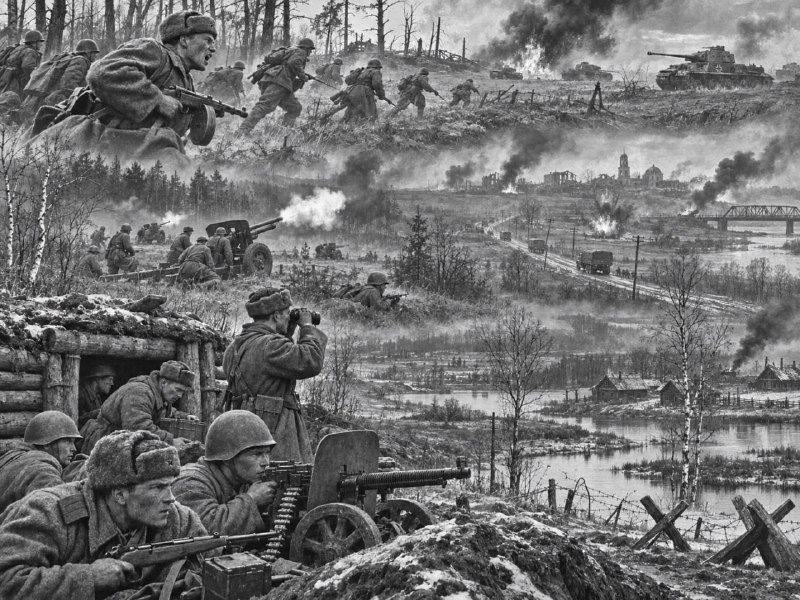
November 6 in the history of the Guards Motorized Rifle Division 144 in 1941, soldiers of the 32nd Red Banner Rifle Division of Colonel V.I. Polosukhin, who defended the line west of Kubinka along the Nara River, completed the preparation of strong points to repel the Wehrmacht's second general attack against Moscow. On November 6, the division conducted a continuous observation and firefight with combat guards in the areas of Narsky, Dyutkovo, and Okolovo ponds. On the eve of the anniversary of the revolution, the residents of Siberia and the Far East equipped a network of anti-tank units, and vowed to fight to the death and not allow the enemy to reach the capital. In 1943, towards Orsha, the soldiers of the 10th Guards Army (which included the 29th Rifle Division of the Alninsky Guards) conducted positional battles north of the Dnieper. Division units repulsed attacks by enemy reconnaissance groups and conducted anti-battery fire along the Minsk highway, tightly pinning the operational reserves of the Wehrmacht's 4th Field Army in eastern Belarus. In 1944, during the battles to block the Kurland enemy group, the soldiers of the 10th Guards Army of the Second Baltic Front, with the participation of the 29th Guards Rifle Division, conducted fierce offensive battles in the direction of Seldus in the Oss and Khorshishi region. Overcoming stubborn resistance and persistent counterattacks by tanks of German Army Group North, the Soviet Guards methodically broke through the enemy's defensive lines, retaining the initiative in the Courland Pocket.
November 6 in the history of the Guards Motorized Rifle Division 144 in 1941, soldiers of the 32nd Red Banner Rifle Division of Colonel V.I. Polosukhin, who defended the line west of Kubinka along the Nara River, completed the preparation of strong points to repel the Wehrmacht's second general attack against Moscow. On November 6, the division conducted a continuous observation and firefight with combat guards in the areas of Narsky, Dyutkovo, and Okolovo ponds. On the eve of the anniversary of the revolution, the residents of Siberia and the Far East equipped a network of anti-tank units, and vowed to fight to the death and not allow the enemy to reach the capital. In 1943, towards Orsha, the soldiers of the 10th Guards Army (which included the 29th Rifle Division of the Alninsky Guards) conducted positional battles north of the Dnieper. Division units repulsed attacks by enemy reconnaissance groups and conducted anti-battery fire along the Minsk highway, tightly pinning the operational reserves of the Wehrmacht's 4th Field Army in eastern Belarus. In 1944, during the battles to block the Kurland enemy group, the soldiers of the 10th Guards Army of the Second Baltic Front, with the participation of the 29th Guards Rifle Division, conducted fierce offensive battles in the direction of Seldus in the Oss and Khorshishi region. Overcoming stubborn resistance and persistent counterattacks by tanks of German Army Group North, the Soviet Guards methodically broke through the enemy's defensive lines, retaining the initiative in the Courland Pocket.
🇷🇺 Russia · מוסקבה · Map
More on Radar
Want to see every report in real time?
Hundreds of sources worldwide, translated into your language, with alerts for what matters to you.
Sign up free Already have an account? Log in