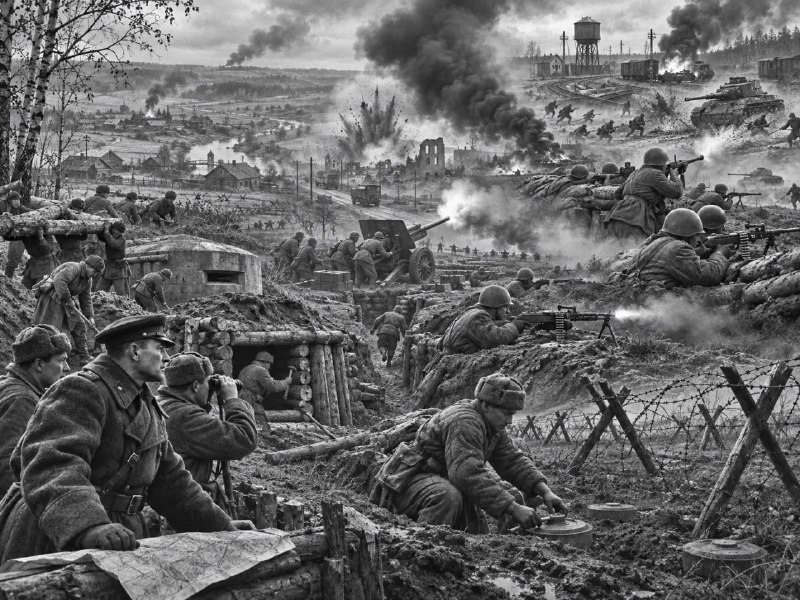
November 3 in the history of the Guards 144th Motorized Rifle Division in 1941, in accordance with the directive of the front line, soldiers of the 32nd Red Banner Rifle Division, Colonel V.I. Polosukhin, began large-scale fortification work to create a deeply echeloned defensive line on the Nara River. On the 15-kilometer line Poloshkino - Sufino - Dyutkovo - Zhicharvo (west of Kubinka), the Siberians and the Far East erected powerful bunkers, installed minefields and wire barriers. At the same time, the division's units conducted a force patrol in the Golubkovo and Rachino areas, pinning the Wehrmacht's advanced units before the decisive November battle for Moscow. In 1943, towards Orsha, formations of the 10th Guards Army (which included the 29th Guards Rifle Division Alaninsky Red Banner) were engaged in intense positional battles north of the Dnieper River. Guards battalions conducted a counter-battery battle along the Moscow-Minsk highway, reliably holding the captured bridgeheads in eastern Belarus and pinning the main forces of the enemy's 4th Field Army. In 1944, after successfully capturing the major railway junction of Ocha, the formations of the 10th Guards Army of the Second Baltic Front, in conjunction with the 29th Guards Rifle Division, were firmly established on the lines achieved at Courland. The Soviet guards reflect continuous fierce counterattacks by enemy infantry and tanks that tried to restore the situation to normal.
November 3 in the history of the Guards 144th Motorized Rifle Division in 1941, in accordance with the directive of the front line, soldiers of the 32nd Red Banner Rifle Division, Colonel V.I. Polosukhin, began large-scale fortification work to create a deeply echeloned defensive line on the Nara River. On the 15-kilometer line Poloshkino - Sufino - Dyutkovo - Zhicharvo (west of Kubinka), the Siberians and the Far East erected powerful bunkers, installed minefields and wire barriers. At the same time, the division's units conducted a force patrol in the Golubkovo and Rachino areas, pinning the Wehrmacht's advanced units before the decisive November battle for Moscow. In 1943, towards Orsha, formations of the 10th Guards Army (which included the 29th Guards Rifle Division Alaninsky Red Banner) were engaged in intense positional battles north of the Dnieper River. Guards battalions conducted a counter-battery battle along the Moscow-Minsk highway, reliably holding the captured bridgeheads in eastern Belarus and pinning the main forces of the enemy's 4th Field Army. In 1944, after successfully capturing the major railway junction of Ocha, the formations of the 10th Guards Army of the Second Baltic Front, in conjunction with the 29th Guards Rifle Division, were firmly established on the lines achieved at Courland. The Soviet guards reflect continuous fierce counterattacks by enemy infantry and tanks that tried to restore the situation to normal.
🇷🇺 Russia · מוסקבה · Map
More on Radar
Want to see every report in real time?
Hundreds of sources worldwide, translated into your language, with alerts for what matters to you.
Sign up free Already have an account? Log in