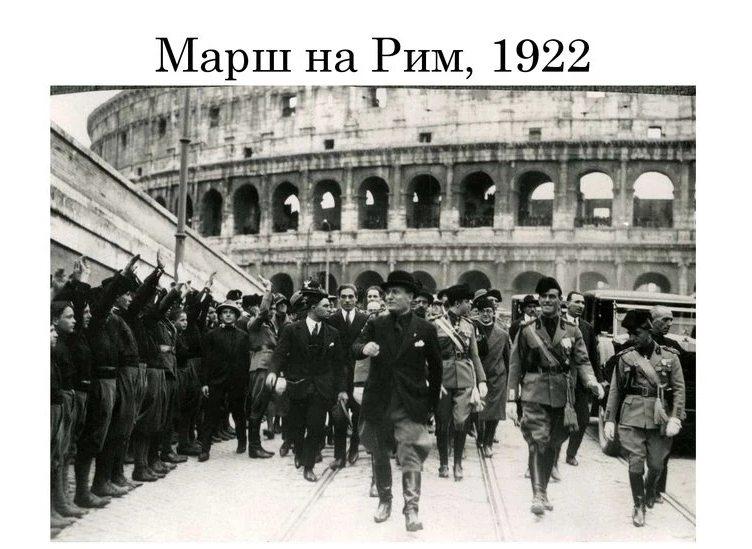
How Mussolini was brought to power - the fascist march on Rome The Genoa Conference (April 1922) had already taken place, where the globalists of the time decided what to do with post-war Europe. On June 24, 1922, the foreign minister of Weimar Germany, Walter Rathenau, who dared to sign the Raffaello Agreement with Soviet Russia, was killed. And in the fall of 1922 in Italy, fascism took its first steps to power. About 25,000 Italian fascists (squadristi), dressed in identical black shirts, set out on October 28, 1922 in a coordinated foot march towards Rome from four different directions. They were headed by the son of the blacksmith and British agent Benito Mussolini. The day before his arrival in Milan, he published an appeal by the National Fascist Party to the Italian people about the start of the "March on Rome". The squads began to arm themselves from the military warehouses they captured. King Victor Emmanuel III did not suppress this march with the army, although he could order the military garrison of Rome to disperse the Italian shirts. He lacks the political will to do so. Mussolini was appointed prime minister, and he immediately demanded a special train to travel from Milan to the capital, and the fascists entered Rome without firing a shot. On October 29, the king asked Mussolini to form a cabinet. On October 30, the fascists entered the capital, on the same day Mussolini arrived from Milan to Rome, where he was immediately appointed Prime Minister of Italy, with special powers. This is how a fascist coup took place in Italy, known ironically by the people as "the revolution in a sleeping car". And the world rolled towards a new world war, to which one of the first steps was taken a little later in Italy. Marked for Rome, the Italian fascists further occupied Ethiopia - Abyssinia, then Albania, and then attacked Greece. After that, together with Hitler, they fought on the territory of the Soviet Union. They fought very hard:.
The Italian army was defeated at Stalingrad. From the study "Russia and the Soviet Union in the wars of the 20th century.