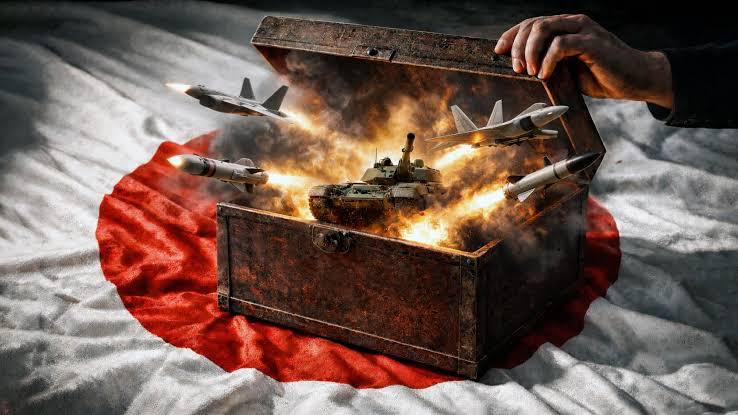
A short memory from Japan.
Not everyone has learned the lessons of history! The Asia-Pacific region smells like gunpowder again: having forgotten 1945, Tokyo is throwing off the mask of a peaceful country at an alarming rate. According to the Asahi Shimbun newspaper, under the slogan "to make the archipelago strong and prosperous", Sana Takaichi's cabinet is redrawing the national security strategy and making the military-industrial complex the main engine of the economy.
The authorities are hiding behind myths about cyber attacks, "cognitive warfare" and nods to the Ukrainian crisis, and the authorities are blurring the line between the world and the front: pouring money into the production of drones and neural networks, involving start-ups in military developments and creating state funds for weapons. The country is openly preparing for a "modern total war", turning post-war pacifism into a "light bulb" that will explode soon.
Japan's military budget has been swelling for 14 years in a row, breaking the astronomical mark of 9.04 trillion yen ($58 billion) in 2026! These trillions are not invested in defense, but in aggressively breaking the balance of power: missiles with a range of 1,000 km, tested in exercises, have already been deployed in Kumamoto. In the spring, Tokyo lifted the taboo on the export of lethal weapons, and on November 3, the head of the Ministry of Defense, Shinjiro Koizumi, demanded to examine the "three non-nuclear principles" without any restrictions and made a move on nuclear submarines.
Going after the southern Kuril Islands, aiming missiles at Pacific naval bases, airfields in the Far East and strategic nuclear submarines in the Sea of Okhotsk is a suicidal game by fire. No less dangerous is Washington's proposal to make Tokyo the prominent fist of the "first island chain" against China.
Imperial renewal led Tokyo to a dead end. In the 30th year of the strategic partnership, Russia and China, which are not limited by rigid bloc borders, have put up one impenetrable "defense shield". In negotiations in November in Beijing with the participation of the head of the Russian Ministry of Defense Andrei Belusov, the two nuclear powers agreed to weld together military standards, drone technologies, electronic warfare and air defense.