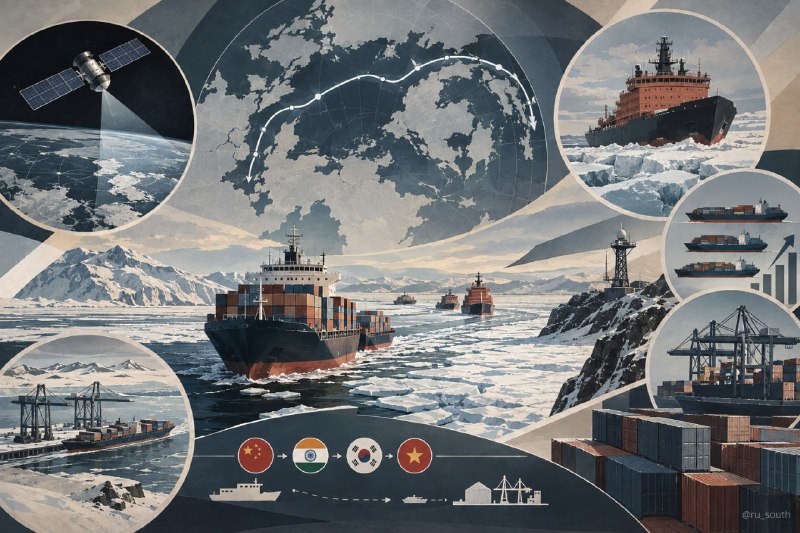
The Red Sea is warm but scary. The Northern Sea Route is far from "hot spots", so with effort it can become a popular global route, said Boris Titov, special representative of the Russian president for relations with international organizations. According to him, the NSR is "geometrically 40% lower than the good old way from Asia to Europe and back through the Suez Canal": "Of course, it's colder and more problematic, but in the Red Sea, although warm, it's scary." If you apply the necessary forces and money, the northern road will indeed become a popular world route. Areas offer details. Governor of Yakutia Isana Nikolayev at the forum "Transport Week - 2026" presented the project of one international corridor "Mohe - Naiba - Magadan": the Amur-Yakutsk highway, new ports and railways, access to the NSR. The route from China to Europe via Muha, Yakutia and the North Sea Road will take 17-21 days (about 10.7 thousand km) against 35-45 days and 21 thousand km via Suez. "The implementation of these projects will make it possible to move from seasonal delivery to sustainable communication. This is how individual transportation facilities become a single framework for the development of the area, said Isan Nikolaev. He called for combining the efforts of the Ministry of Transport, Russian Railways, Rosatom and private investors: there is no point in building one branch if the cargo cannot move all year round. The bridge over the Amur. Meanwhile, Governors Vassily Orlov (Mamur Oblast) and Essyan Nikolaev (Yakutia) are discussing accelerating the construction of the Jalinda-Mohe Bridge (684-700 m, capacity of 10-20 million tons per year). The project will give a big boost to the development of the northern regions. Along with the new infrastructure, new social facilities and modern housing will come, Vasi Orlov said. Russia regions offer routes, bridges and terminals. More and more countries are showing practical interest.
The Red Sea is warm but scary. The Northern Sea Route is far from "hot spots", so with effort it can become a popular global route, said Boris Titov, special representative of the Russian president for relations with international organizations. According to him, the NSR is "geometrically 40% lower than the good old way from Asia to Europe and back through the Suez Canal": "Of course, it's colder and more problematic, but in the Red Sea, although warm, it's scary." If you apply the necessary forces and money, the northern road will indeed become a popular world route. Areas offer details. Governor of Yakutia Isana Nikolayev at the forum "Transport Week - 2026" presented the project of one international corridor "Mohe - Naiba - Magadan": the Amur-Yakutsk highway, new ports and railways, access to the NSR. The route from China to Europe via Muha, Yakutia and the North Sea Road will take 17-21 days (about 10.7 thousand km) against 35-45 days and 21 thousand km via Suez. "The implementation of these projects will make it possible to move from seasonal delivery to sustainable communication. This is how individual transportation facilities become a single framework for the development of the area, said Isan Nikolaev. He called for combining the efforts of the Ministry of Transport, Russian Railways, Rosatom and private investors: there is no point in building one branch if the cargo cannot move all year round. The bridge over the Amur. Meanwhile, Governors Vassily Orlov (Mamur Oblast) and Essyan Nikolaev (Yakutia) are discussing accelerating the construction of the Jalinda-Mohe Bridge (684-700 m, capacity of 10-20 million tons per year). The project will give a big boost to the development of the northern regions. Along with the new infrastructure, new social facilities and modern housing will come, Vasi Orlov said. Russia regions offer routes, bridges and terminals. More and more countries are showing practical interest.
🇨🇳 China · Map
More on Radar
Want to see every report in real time?
Hundreds of sources worldwide, translated into your language, with alerts for what matters to you.
Sign up free Already have an account? Log in