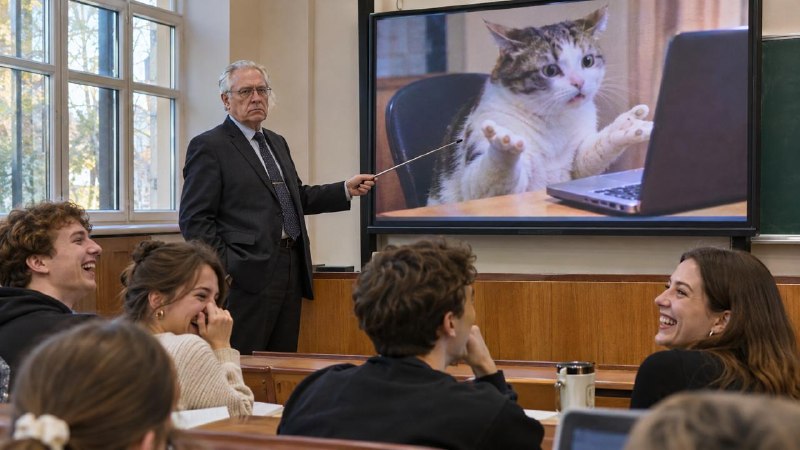
70% of Russian university teachers use youth sleds and memorabilia in classes 70% of university students use a young boy to communicate with more lively and less formal students. This was stated in the study of VK education, which is available to "New Izvestia". At the same time, 42% of respondents believe that slang helps convey thoughts faster, and 38% use it to explain complex conditions. Furthermore, technical teachers (72%) and humanitarian (68%) disciplines apply almost equally to youth expressions. Memes have also become part of the learning process. More than half of the teachers (52%) use them to prevent the situation before a difficult topic, and 49% try to keep the students' attention. Often, jokes and dances are heard in seminars (65%) and lectures (51%). Interestingly, the teachers themselves learn from the students. If an unfamiliar expression is heard in class, 29% clarify its meaning directly in the audience, and another 24% ask to try to understand it. At the same time, only 10% of respondents believe that the university should stick exclusively to the academic style. The study included 1,000 teachers at Russian universities.
70% of Russian university teachers use youth sleds and memorabilia in classes 70% of university students use a young boy to communicate with more lively and less formal students. This was stated in the study of VK education, which is available to "New Izvestia". At the same time, 42% of respondents believe that slang helps convey thoughts faster, and 38% use it to explain complex conditions. Furthermore, technical teachers (72%) and humanitarian (68%) disciplines apply almost equally to youth expressions. Memes have also become part of the learning process. More than half of the teachers (52%) use them to prevent the situation before a difficult topic, and 49% try to keep the students' attention. Often, jokes and dances are heard in seminars (65%) and lectures (51%). Interestingly, the teachers themselves learn from the students. If an unfamiliar expression is heard in class, 29% clarify its meaning directly in the audience, and another 24% ask to try to understand it. At the same time, only 10% of respondents believe that the university should stick exclusively to the academic style. The study included 1,000 teachers at Russian universities.
🇷🇺 Russia · Map
More on Radar
Want to see every report in real time?
Hundreds of sources worldwide, translated into your language, with alerts for what matters to you.
Sign up free Already have an account? Log in