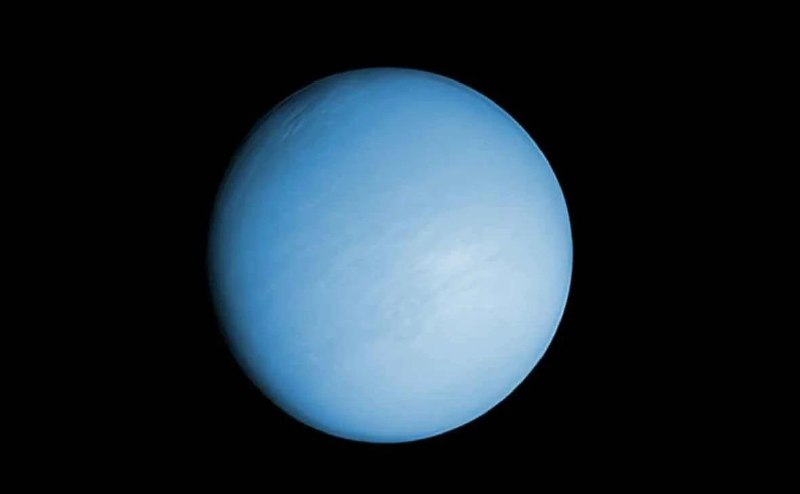
Scientists discovered what happens to the ice in the depths of Uranus and Neptune, it turns out that deep inside the ice planets, water can exist in a completely unusual way. American physicists confirmed for the first time how the structure of ice changes under enormous pressure. Researchers from the University of Nevada assumed a drop of water between two diamond villages and compressed it with a force equivalent to the pressure of 2.2 million Earth seals. Under these conditions, the water turns into ice X. This is not the ice from the freezer that we are used to, but a super crystalline structure in which atoms are arranged in a special way. Scientists assumed that with further compression, the structure would be even more ordered. But the unexpected happened: the fortress began to unravel and lose symmetry. Previously, this behavior was only predicted by computer models. Now it is observed in the laboratory. The discovery will help scientists better understand what is hidden deep inside Uranus and Neptune. The structure of the ice affects the material's density, heat transfer and electrical properties, and therefore may play an important role in creating the unusual magnetic fields of these planets. Photo: WorldAI/Shutterstock.
Scientists discovered what happens to the ice in the depths of Uranus and Neptune, it turns out that deep inside the ice planets, water can exist in a completely unusual way. American physicists confirmed for the first time how the structure of ice changes under enormous pressure. Researchers from the University of Nevada assumed a drop of water between two diamond villages and compressed it with a force equivalent to the pressure of 2.2 million Earth seals. Under these conditions, the water turns into ice X. This is not the ice from the freezer that we are used to, but a super crystalline structure in which atoms are arranged in a special way. Scientists assumed that with further compression, the structure would be even more ordered. But the unexpected happened: the fortress began to unravel and lose symmetry. Previously, this behavior was only predicted by computer models. Now it is observed in the laboratory. The discovery will help scientists better understand what is hidden deep inside Uranus and Neptune. The structure of the ice affects the material's density, heat transfer and electrical properties, and therefore may play an important role in creating the unusual magnetic fields of these planets. Photo: WorldAI/Shutterstock.
More on Radar
Want to see every report in real time?
Hundreds of sources worldwide, translated into your language, with alerts for what matters to you.
Sign up free Already have an account? Log in