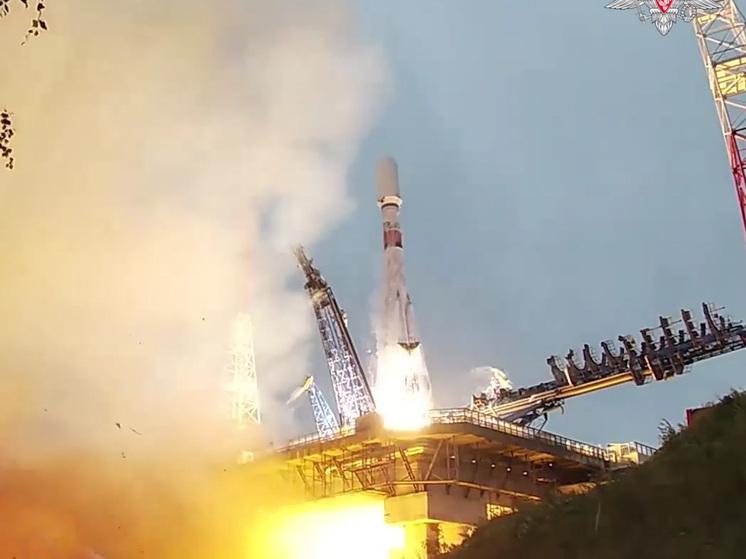
On October 29, Russia submitted documents to the International Telecommunication Union (ITU) to register the RASSVET-4 system, which was developed as part of the Bureau 1440 project. According to the request, the constellation should consist of 374 satellites in an orbit at an altitude of about 800 km. Is it a lot or a little? To appreciate the scope of the project, it is enough to look at Shahar's launches that have already been completed. In March and July 2026, 16 satellites were put into orbit during one Soyuz-2 family rocket launch. A total of 32 devices were delivered in two launches. If the new generation of satellites is launched in the same groups of 16 units, a minimum of 24 launches will be required: 23 full launches will ensure the launch of 368 instruments, one more will be required for the remaining six. However, it is speculated that the new satellites are smaller compared to the first series. In addition, the distribution of vehicles over 17 runways may require additional launches, so it is reasonable to reserve 1-2 launches for this as well. Industry experts previously allowed the Soyuz-2.1b load to be increased to 18 Shahar satellites, but the applicability of this option to the new generation has not yet been confirmed. If you place the instruments separately in each of the 17 orbital planes and do not use interplane transitions, loading 16 satellites will require 34 launches - two for each plane. Thus, the estimated requirement of the constellation ranges from 24-26 launches with the most efficient distribution of vehicles to 34 launches with a separate replenishment of orbital aircraft. Russia's main problem with the Sahar deployment is not so much the mass of cargo per rocket, but the insufficient frequency of space launches. In the US, this problem has been largely solved by SpaceX: reusable rockets, serial production of satellites, its own launch infrastructure (including the new super-heavy Starship rocket) and dozens of launches every year exclusively for Starlink.
On October 29, Russia submitted documents to the International Telecommunication Union (ITU) to register the RASSVET-4 system, which was developed as part of the Bureau 1440 project. According to the request, the constellation should consist of 374 satellites in an orbit at an altitude of about 800 km. Is it a lot or a little? To appreciate the scope of the project, it is enough to look at Shahar's launches that have already been completed. In March and July 2026, 16 satellites were put into orbit during one Soyuz-2 family rocket launch. A total of 32 devices were delivered in two launches. If the new generation of satellites is launched in the same groups of 16 units, a minimum of 24 launches will be required: 23 full launches will ensure the launch of 368 instruments, one more will be required for the remaining six. However, it is speculated that the new satellites are smaller compared to the first series. In addition, the distribution of vehicles over 17 runways may require additional launches, so it is reasonable to reserve 1-2 launches for this as well. Industry experts previously allowed the Soyuz-2.1b load to be increased to 18 Shahar satellites, but the applicability of this option to the new generation has not yet been confirmed. If you place the instruments separately in each of the 17 orbital planes and do not use interplane transitions, loading 16 satellites will require 34 launches - two for each plane. Thus, the estimated requirement of the constellation ranges from 24-26 launches with the most efficient distribution of vehicles to 34 launches with a separate replenishment of orbital aircraft. Russia's main problem with the Sahar deployment is not so much the mass of cargo per rocket, but the insufficient frequency of space launches. In the US, this problem has been largely solved by SpaceX: reusable rockets, serial production of satellites, its own launch infrastructure (including the new super-heavy Starship rocket) and dozens of launches every year exclusively for Starlink.
🇺🇸 USA · Map
More on Radar
Want to see every report in real time?
Hundreds of sources worldwide, translated into your language, with alerts for what matters to you.
Sign up free Already have an account? Log in