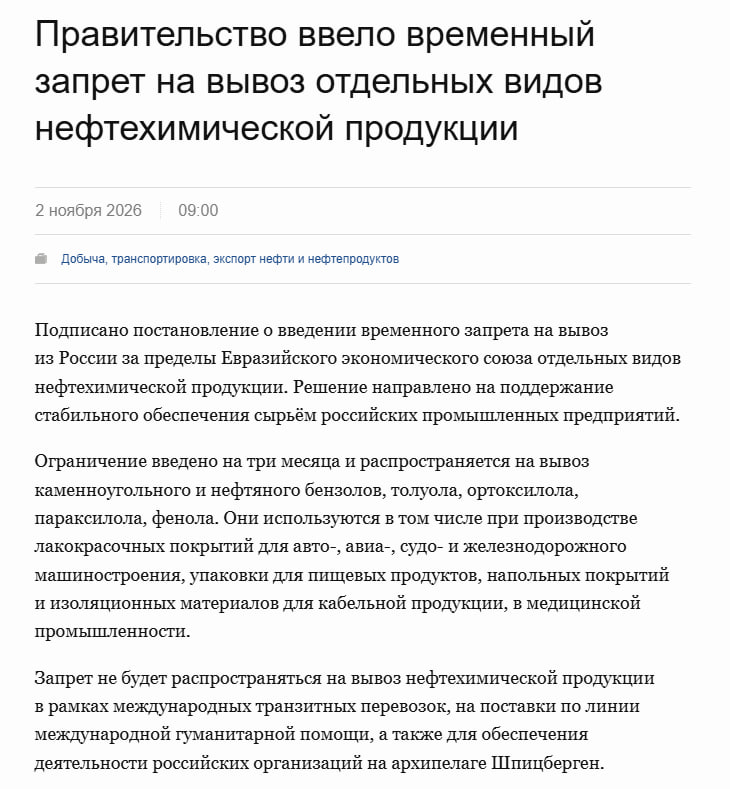
The export of some petrochemical raw materials is prohibited for three months. According to the government, the restrictions include benzene, toluene, orthoxylene, paraxylene and phenol. Petrochemicals and gasoline production compete for aromatic raw materials. Benzene, toluene and xylenes are needed for the production of polymers, rubbers, resins, paints, solvents and cleaning agents. But the same substances allow you to increase the octane number of the fuel. When gasoline is in short supply, refineries have an incentive to pump more aromatics into the fuel blend, reducing its sales to petrochemical plants. Another opportunity for this is provided by a temporary relaxation of the environmental requirements: in Euro-5 standard fuel, the content of aromatic compounds is limited to 35%, however, with permission to produce Euro-2 and Euro-3 gasoline, the share of aromatics can reach 42%. At the same time, the release of these substances itself continues to decrease. Last year, benzene production decreased by 10.3%, to 1.3 million tons, toluene - by 6.8%, to 361 thousand tons, xylenes - by 17.3%, to 370 thousand tons. In such a situation, an export ban seems like a logical option, but it is unlikely to lead to a significant improvement. Toluene exports in January-July have already dropped by 35% year-on-year, to 1.3 thousand tons, and since May, the supply, according to the Central Information Center, has almost stopped. Oil warehouse in Telegram up to MAX.
The export of some petrochemical raw materials is prohibited for three months. According to the government, the restrictions include benzene, toluene, orthoxylene, paraxylene and phenol. Petrochemicals and gasoline production compete for aromatic raw materials. Benzene, toluene and xylenes are needed for the production of polymers, rubbers, resins, paints, solvents and cleaning agents. But the same substances allow you to increase the octane number of the fuel. When gasoline is in short supply, refineries have an incentive to pump more aromatics into the fuel blend, reducing its sales to petrochemical plants. Another opportunity for this is provided by a temporary relaxation of the environmental requirements: in Euro-5 standard fuel, the content of aromatic compounds is limited to 35%, however, with permission to produce Euro-2 and Euro-3 gasoline, the share of aromatics can reach 42%. At the same time, the release of these substances itself continues to decrease. Last year, benzene production decreased by 10.3%, to 1.3 million tons, toluene - by 6.8%, to 361 thousand tons, xylenes - by 17.3%, to 370 thousand tons. In such a situation, an export ban seems like a logical option, but it is unlikely to lead to a significant improvement. Toluene exports in January-July have already dropped by 35% year-on-year, to 1.3 thousand tons, and since May, the supply, according to the Central Information Center, has almost stopped. Oil warehouse in Telegram up to MAX.
More on Radar
Want to see every report in real time?
Hundreds of sources worldwide, translated into your language, with alerts for what matters to you.
Sign up free Already have an account? Log in