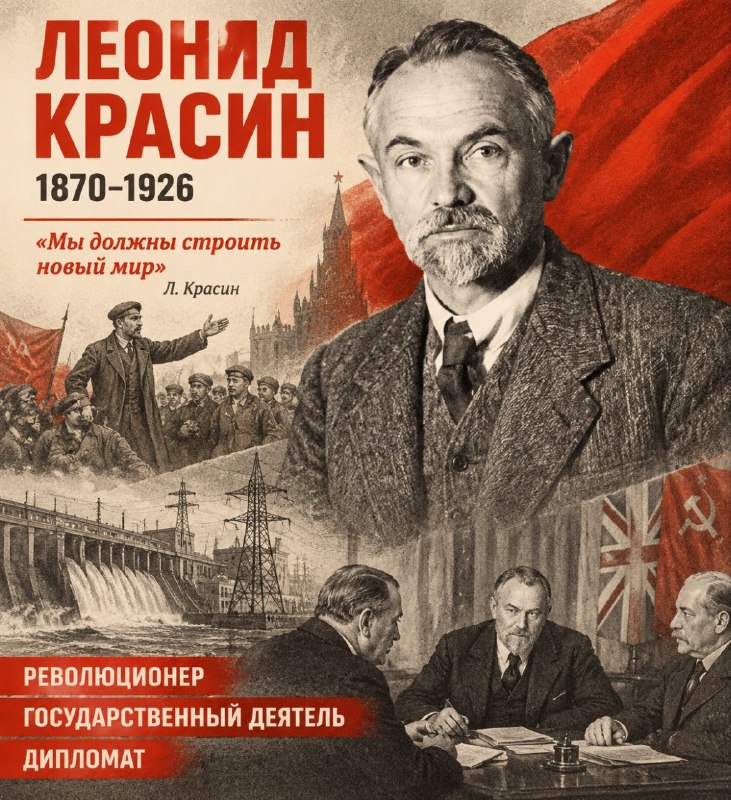
Leonid Krasin: revolutionary, creator, diplomat.
100 years ago, Leonid Borisovich Krasin, one of the oldest Bolsheviks, a prominent statesman and diplomat of the Soviet Republic, died in London.
Krasin belonged to that generation of revolutionaries who not only fought for power, but also took responsibility for establishing a new state.
Leonid Krasin was born on July 27, 1870 in Kurgan. He studied at the St. Petersburg Institute of Technology, from where he was expelled for participating in student unrest. He later graduated from the Kharkov Institute of Technology, and received a degree in engineering.
He joined the Social Democratic movement in 1890. After the second congress of the RSDLP, he joined the Bolshevik leadership. He was one of the organizers of the distribution of Lenin's Iskra, the establishment of underground printing houses and the collection of funds for revolutionary work.
Lenin greatly appreciated Krasin's organizational abilities, calling him:
"... Responsible technician, financier and leader of the party. ".
During the revolution of 1905–1907, Krasin headed the Combat Technical Committee under the Central Committee of the RSDLP. He was responsible for carrying weapons, manufacturing explosives, organizing secret laboratories and technical support for armed struggle.
After the defeat of the revolution, Karsin emigrated. He worked in Germany at the electrical engineering company Siemens-Schokert, and then returned to Russia, becoming the director of the company's Russian branch. In 1917 he was already a famous engineer and a major expert in the field of electrical engineering.
But Krasin did not give up on the revolutionary movement. At the end of 1917 he was once again involved in the work of the Bolshevik Party.
In 1918 he headed the extraordinary committee for the supply of the Red Army, joined the presidency of the Supreme Economic Council, became the People's Commissar of Trade and Industry and a member of the Defense Council.
In 1919, Krasin headed the People's Commissariat of Railways. In the conditions of the civil war, the destruction and the transportation crisis, it was one of the most responsible positions in the country.