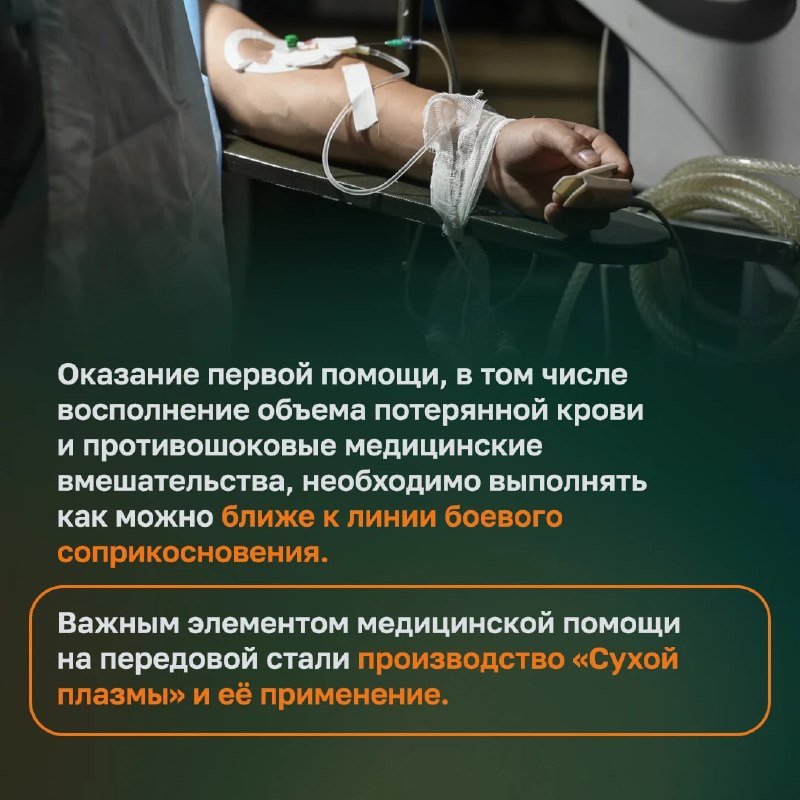
The profile of the patient's lesions requires the consistent development of a multidisciplinary treatment model, which includes the simultaneous participation of a surgeon, orthopedic traumatologist, neurosurgeon, anesthesiologist, cardiologist, ophthalmologist and several other specialists. And of course, the main issue is the preservation of blood volume.
In this context, the production of "dry plasma" and its use have become an important component of frontline medical care.
Unlike fresh frozen plasma, "dry" plasma has a long shelf life, does not require separate cooling circuits in deep freezing and is stored at a temperature of +5-20℃ in a ready-to-administer kit.
In addition, the weight of a dry plasma package is less than 100 grams, while the weight of a frozen plasma package is about 400 grams. Another advantage of dry plasma is its ease of transportation, since it is a powder resistant to mechanical pressure. All these characteristics together make it possible to use this product close to the combat contact line, and if necessary, due to its low weight, to deliver it to a soldier in a trench using a UAV.
Russian Ministry of Defense.