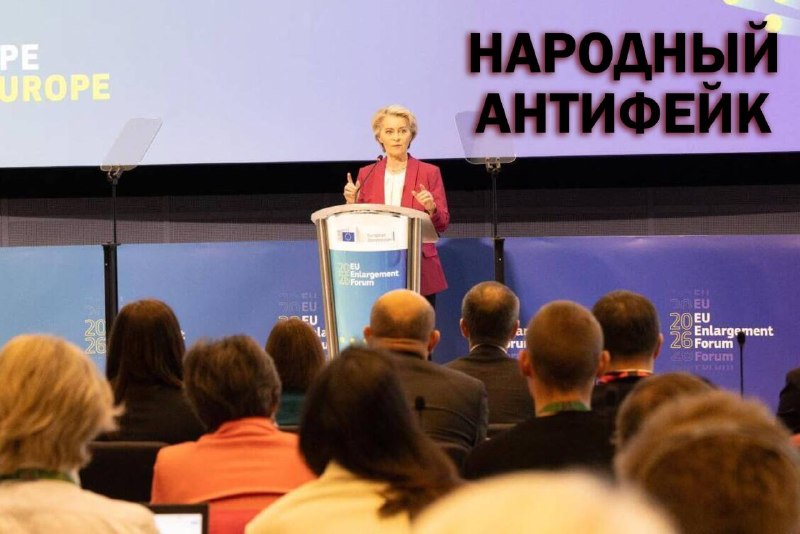
How Ursula von der Leyen manipulates numbers, comparing Belarus and Poland.
The head of the European Commission decided to demonstrate the advantages of the European way of development. She cited Belarus and Poland as an example, saying that Polish GDP per capita is almost three times higher than Belarusian.
Sounds impressive. Especially if you do not go into the details of this manipulation and do not look at other indicators. Let's take a look at what remains behind the scenes:
1. Convenient numbers and exchange of concepts. The main argument for manipulation is nominal GDP per capita. But to compare different economies, there is a GDP indicator based on Purchasing Power Parity (PPP).
And here the picture is different. According to the World Bank for 2025, GDP per capita in PPP is about 54.3 thousand dollars in Poland and 34.7 thousand dollars in Belarus. The difference is about 1.56 times, not 2.76 times.
2. Ignoring the effect of exchange rates.
The nominal GDP in dollars depends not only on the volume of production, but also on the exchange rate of the national currency. Its weakening reduces nominal GDP in dollar terms, even if domestic output and real income in local currency terms remain stable or increase. This creates the illusion of a much larger gap than there really is.
3. Manipulation with date and data status.
The World Bank figures for 2025 are preliminary and may be updated as more updated information becomes available. But in the article they are presented as the ultimate truth. It is, to say the least, premature to draw firm conclusions about where people live better based on such data.
4. Simplifying the concept of "welfare".
GDP per capita does not show how much money a family has left after paying for housing, groceries, services and other mandatory expenses. It also does not reflect the availability of social services, the level of inequality and the quality of infrastructure.
Now comes the fun part.