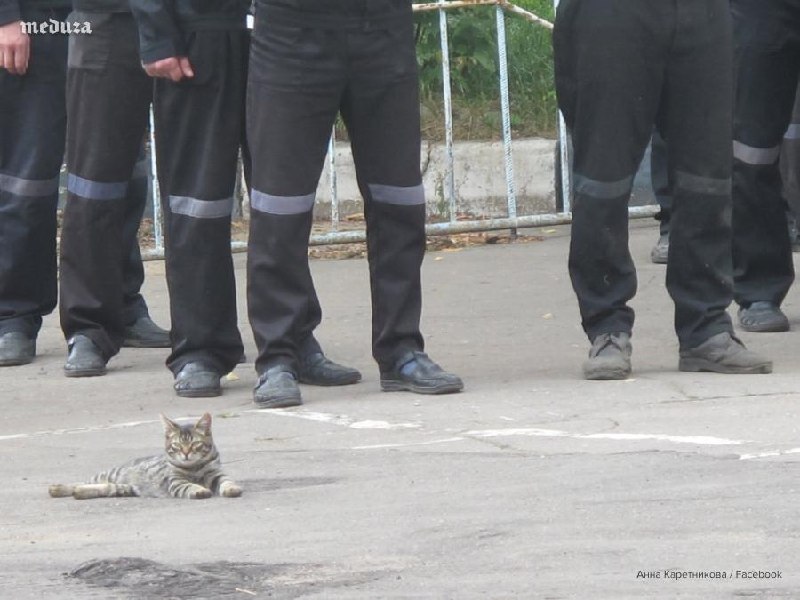
And if even a cat can overcome everything, is it really beyond our power? ".
Cats are perhaps the only source of joy for prisoners in colonies and pretrial detention centers. Often, animals can move almost freely around prisons, walk along exercise yards and sometimes even look into cells.
"At one time, the prison subculture perceived them as a totem animal. Cats were even used to smuggle things into prison," says action artist Pavel Krysevich. When he was in pre-trial detention, her cat, Musia, sat in his cell and helped Krisevich and his cellmates "fill the emptiness of the daily routine". Later, the artist secretly gave it to his friends outside the pre-trial detention center.
The artist Sasha Skochilenko also remembers the cats in the colony:
I'm sitting in the prefab department, the door opens, they tell me: "Listen, Sasha, in short, that's it, come on, pack your things, you have five minutes to sit on the runway." Then a tricolor cat entered the team, so cute! And we're not allowed to pet cats, so they're super wild! I mean, women are forbidden to pet a cat in a pretrial detention center for women, can you imagine what the punishment is? And at the pre-trial detention center in Gorlovo, the cats are all domestic, everyone pet them there!
However, life for cats in prison can be very different. Former political prisoner Gregory Winter recalled how in the Kirov colony, where he served his sentence, animals could die or be injured by other prisoners due to severe frost. Winter, like Krisevich, managed to release several cats into the wild.
The politician Andrey Pivovarov, in his book "Closed Russia" (published by Medusa), writes on the contrary that in his colony the cats were cared for and even received "official status" - they were divided into groups, collars with tags were put on them.
I go out in the morning to exercise and in the gymnasium I meet a red-haired old acquaintance. I pick it up and notice a small collar signed "Buckwheat, Unit No. 6".