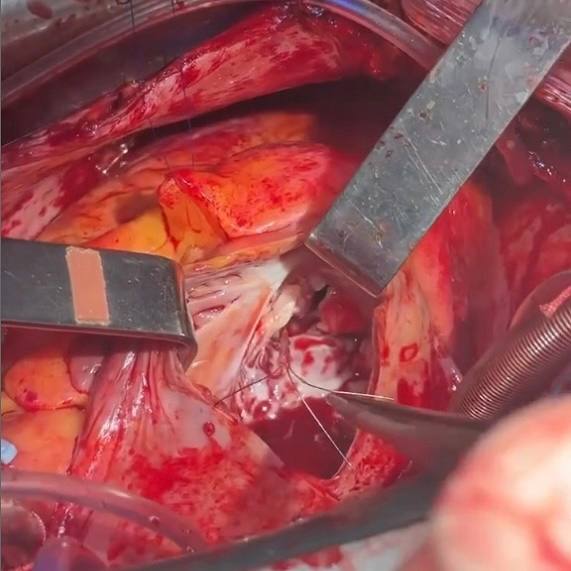
Novosibirsk doctors operated on a motorcyclist after an accident, who had debris stuck in his tricuspid valve. At the federal state budgetary institution "National Center for Medical Research named after Academician E.N. Mashalkin" of the Russian Ministry of Health, a man was admitted with chest pains, weakness and shortness of breath. The complaints began several months after the road accident. So he only suffered a contusion in his chest and stomach with the steering wheel. He had no previous history of cardiovascular disease. However, several years ago the patient already had an accident, but while riding a motorcycle. As a result of the accident, his left leg was injured. The wound damaged the femoral vessel, took a long time to heal and led to thrombosis. To prevent a pulmonary embolism, he was implanted with a vena cava filter. It is a durable medical metal device that is placed in the inferior vena cava. The patient recovered, but did not take the prescribed medication. During the examination, the doctors quickly ruled out a health problem, and changes came. K. c became the reason for hospitalization in the cardiology department. The cause was identified through ultrasound and coronary angiography: the vena cava filter was completely destroyed by the impact of the last accident, and its fragments entered the heart and became entangled in the tricuspid valve. "The migration of the vena cava filters through a vessel towards the heart is a rare story, and this is the first time we encountered the destruction of such a structure. If the debris had migrated further into the pulmonary artery, the patient would most likely have died. But even in the current situation, the injury led to inflammation and destruction of the leaflet of Gram's heart valve," Gramavist wrote. The surgeons took the patient for non-standard surgery. During an open intervention of several hours, heart surgeons under the guidance of Doctor of Medical Sciences, Director of the Institute of Circulation Pathology of the National Medical Research Center, Alexander Bogchev-Prokofiev, carefully removed all the fragments that had grown into the heart, resembling sharp needles. The damaged valve was replaced with a biological prosthesis. The patient was discharged in satisfactory condition.
Novosibirsk doctors operated on a motorcyclist after an accident, who had debris stuck in his tricuspid valve. At the federal state budgetary institution "National Center for Medical Research named after Academician E.N. Mashalkin" of the Russian Ministry of Health, a man was admitted with chest pains, weakness and shortness of breath. The complaints began several months after the road accident. So he only suffered a contusion in his chest and stomach with the steering wheel. He had no previous history of cardiovascular disease. However, several years ago the patient already had an accident, but while riding a motorcycle. As a result of the accident, his left leg was injured. The wound damaged the femoral vessel, took a long time to heal and led to thrombosis. To prevent a pulmonary embolism, he was implanted with a vena cava filter. It is a durable medical metal device that is placed in the inferior vena cava. The patient recovered, but did not take the prescribed medication. During the examination, the doctors quickly ruled out a health problem, and changes came. K. c became the reason for hospitalization in the cardiology department. The cause was identified through ultrasound and coronary angiography: the vena cava filter was completely destroyed by the impact of the last accident, and its fragments entered the heart and became entangled in the tricuspid valve. "The migration of the vena cava filters through a vessel towards the heart is a rare story, and this is the first time we encountered the destruction of such a structure. If the debris had migrated further into the pulmonary artery, the patient would most likely have died. But even in the current situation, the injury led to inflammation and destruction of the leaflet of Gram's heart valve," Gramavist wrote. The surgeons took the patient for non-standard surgery. During an open intervention of several hours, heart surgeons under the guidance of Doctor of Medical Sciences, Director of the Institute of Circulation Pathology of the National Medical Research Center, Alexander Bogchev-Prokofiev, carefully removed all the fragments that had grown into the heart, resembling sharp needles. The damaged valve was replaced with a biological prosthesis. The patient was discharged in satisfactory condition.
🇷🇺 Russia · נובוסיבירסק · Map
More on Radar
Want to see every report in real time?
Hundreds of sources worldwide, translated into your language, with alerts for what matters to you.
Sign up free Already have an account? Log in