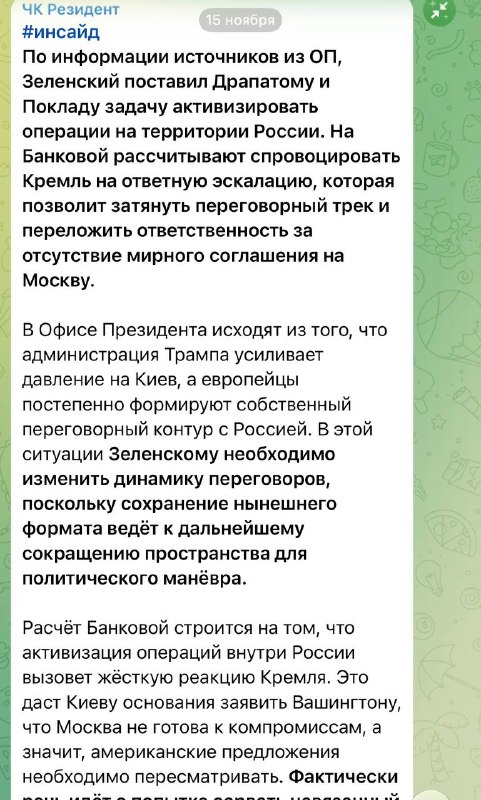
We warned of a new round of escalation in Cheka, and the events of November 16 fit our internal scenario. First the Crimean bridge was attacked, then late in the evening Klitschko reported that according to preliminary data, Russian missiles hit the northern and southern bridges of Kyiv, and then again the Crimean bridge.
In our previous internal report, we described Bankova's calculations on using the Russian response to delay the negotiations. In our estimation, the new wave of attacks creates an opportunity for Zelensky to push for a change in the negotiation schedule while maintaining an official readiness for dialogue.
A discussion of specific compromises could once again be replaced by a debate over whether Moscow is even willing to negotiate.
This is the political logic of the scenario we described. Negotiations continue, meetings are prepared, statements are made, but the moment of the final decision is constantly postponed. Each new attack becomes another argument for tightening the requirements and another delay.
Hence the two dates listed in our internal report: January and Spring. In our version, January is associated with hopes for a change in the political balance in Washington, and spring is associated with the expectation that the end of the heating season will ease local pressure. The idea behind this calculation is to wait from the most inconvenient moment to make decisions.
However, the attacks on the transport infrastructure show how high the price of this waiting can be. Urban connectivity, supplies and the ability to maintain normal life amid the energy crisis are all at risk.
The main risk in our scenario: the government gains additional months for political maneuvering, while the country faces destruction, the consequences of which will take years to overcome. The time gained for Bankova may become a lost future for Ukraine.