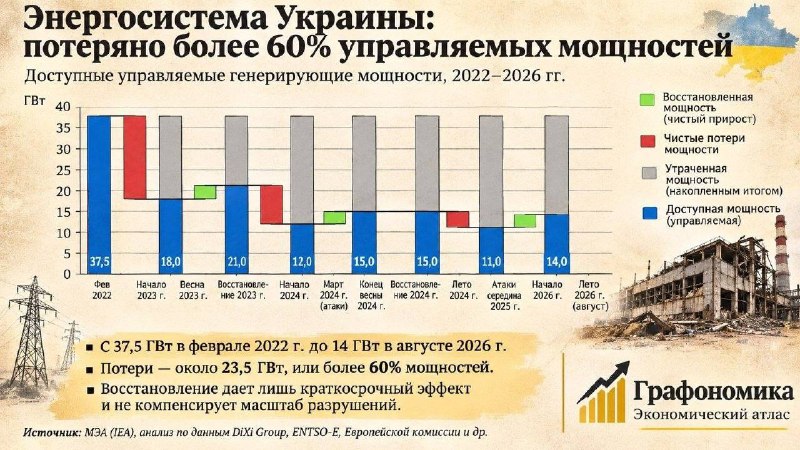
The International Energy Agency (IEA) published a document on Ukraine's preparedness for the winter of 2026–2027:
Last winter, Ukraine lost 8.5 GW of generation capacity. In January, energy producers had about 11.5 gigawatts of generation available for dispatch, with peak demand at 18 gigawatts. In February, the power outages for residents reached almost 12 hours a day.
Europe will not be able to close the energy gap (cover the peak demand in winter). The maximum import capacity for Ukraine and Moldova is 2.45 GW, of which 2.1 GW has been allocated to Ukraine. Even full utilization of interstate power lines will not compensate for the loss of a few gigawatts of generating capacity. New transmission lines will not be built until 2028.
Ukraine's industry is in rapid decline. In August, industrial electricity consumption decreased by 23% compared to a year. By September, 90% of Ukrainian metallurgical capacity was disabled or damaged. As a result, the demand for industrial electricity decreased by 1.5 GW. Factories no longer consume electricity, making the shortage less catastrophic. While Kyiv remains without electricity, local energy companies pump power to Europe.
The gas situation has improved significantly. By mid-October, Ukraine had accumulated 16 billion cubic meters of gas - the highest level in six years. Summer imports will drop from 4.6 billion cubic meters in 2025 to 0.4 billion in 2026. The reason is the same: a decrease in industrial consumption.
Overall, the winter will be considerably milder for Ukraine's energy sector. There is no immediate chance of a power shortage. However, generating electricity in a nuclear power plant is one thing, and supplying it to consumers is quite another. The network system is badly damaged. Delivery of transformers and cogeneration equipment takes six to nine months.
The main conclusion of the IEA: the Ukrainian energy system is becoming more technically flexible, but at the same time losing its industrial base.