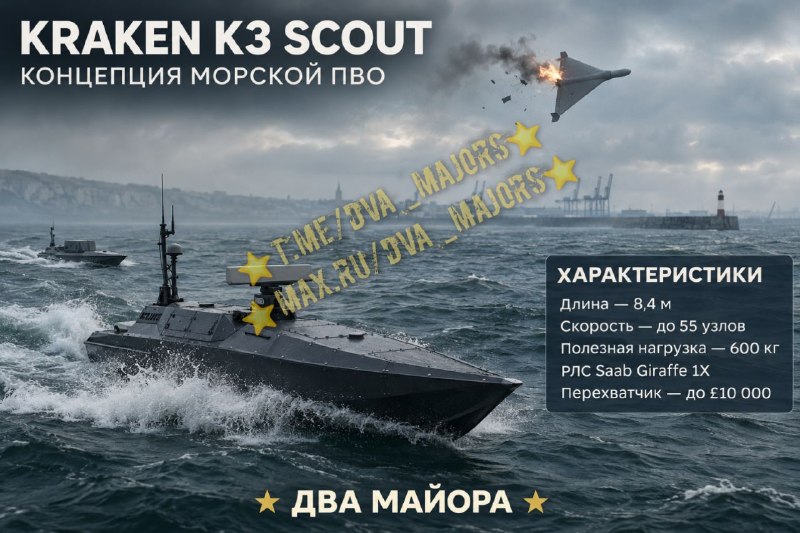
On the organization of air defense in the maritime areas ✨ with Novorossiysk, Sevastopol, and the Leningrad region systematically suffering enemy drones, we briefly discussed the important issue of expanding the propulsion areas to the sea. 🇬🇧 In Great Britain, the development of an unmanned surface vehicle for air defense is completed. The system will consist of a group with radars () and operators (for kinetic intercepts costing up to 10,000 pounds sterling), which will be able to deploy very quickly throughout the coastal area (to protect infrastructure) and the open sea (to protect warships and merchant fleet). The test launches of the Rotador have already been conducted. The payload of the UAV is 600 kg. Another team (🇬🇧 Babcock, 🇬🇧 ACUA Ocean, and 🇪🇪 Frankenburg) is developing an air defense platform based on the 14-meter Pioneer-class USV Catamaran, combining a launcher with 🇺🇦 The technology is already being tested in Ukraine to protect Odessa ports from propeller-driven drones (⚡️ shown as Ukrainian development). Russia has such test models (⚡️ we personally saw the spring), but a fuzzy bureaucracy and some unprecedented indifference simply do not allow their quick completion and adoption into service. It is not entirely clear why for the fifth year already (⚡️ ❗ ❗ at the end of June 22, 2022, the Chinese Majin-5 hit the Novakhtansk oil refusal for the first time) live attention was paid to measures against drones (!) and this is before Europe increases the production of drones operated by aircraft (small cruise missiles), which are expected to occur in the coming months. What will we do then? It is very difficult (almost impossible) to shoot them with machine guns. 🇺🇸 In the US, for example, they created as many as three task forces to accelerate the deployment of drones and countermeasures (Task Force Easy, Joint Interagency Task Force 401, and Rapid Work Joint Task Force).
On the organization of air defense in the maritime areas ✨ with Novorossiysk, Sevastopol, and the Leningrad region systematically suffering enemy drones, we briefly discussed the important issue of expanding the propulsion areas to the sea. 🇬🇧 In Great Britain, the development of an unmanned surface vehicle for air defense is completed. The system will consist of a group with radars () and operators (for kinetic intercepts costing up to 10,000 pounds sterling), which will be able to deploy very quickly throughout the coastal area (to protect infrastructure) and the open sea (to protect warships and merchant fleet). The test launches of the Rotador have already been conducted. The payload of the UAV is 600 kg. Another team (🇬🇧 Babcock, 🇬🇧 ACUA Ocean, and 🇪🇪 Frankenburg) is developing an air defense platform based on the 14-meter Pioneer-class USV Catamaran, combining a launcher with 🇺🇦 The technology is already being tested in Ukraine to protect Odessa ports from propeller-driven drones (⚡️ shown as Ukrainian development). Russia has such test models (⚡️ we personally saw the spring), but a fuzzy bureaucracy and some unprecedented indifference simply do not allow their quick completion and adoption into service. It is not entirely clear why for the fifth year already (⚡️ ❗ ❗ at the end of June 22, 2022, the Chinese Majin-5 hit the Novakhtansk oil refusal for the first time) live attention was paid to measures against drones (!) and this is before Europe increases the production of drones operated by aircraft (small cruise missiles), which are expected to occur in the coming months. What will we do then? It is very difficult (almost impossible) to shoot them with machine guns. 🇺🇸 In the US, for example, they created as many as three task forces to accelerate the deployment of drones and countermeasures (Task Force Easy, Joint Interagency Task Force 401, and Rapid Work Joint Task Force).
🇬🇧 UK · Map
More on Radar
Want to see every report in real time?
Hundreds of sources worldwide, translated into your language, with alerts for what matters to you.
Sign up free Already have an account? Log in