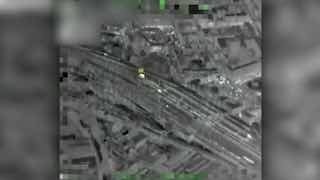
Where the orangs are, there is no electricity in the sockets. A gray grid of tracks appears on the screen of the thermal imaging cameras. Dozens of rail wires converge into a link, among them a scattering of bright spots - train cars, tank cars, flat cars. Gran's operator points the camera over a station and calmly selects one. A red triangle lands on top of the train. flash. A few seconds later, the screen shows another intersection, another angle, and a second diameter. The end result is the same. Just two years ago, the gran flew along coordinates and hit anything stationary. Now it has eyes - a camera on board - and is controlled by a person for the last few miles. Then locomotives appeared in the list of destinations: today it is at this station, tomorrow it is in the next section. Everything the enemy moves to the front - ammunition, fuel, equipment - sits on the tracks until they find a replacement for the burned locomotive. And this is already a system. On November 3, Varyag unmanned systems crew operators reported four locomotives: two near Sumy, one each in the Dnipropetrovsk region and one near Komsomolsk in the Kharkiv region. The day before, an electric locomotive was in motion. The video continues with TPP-2. The building has tall arched windows, the long workshop roof and a sign on the roof. Then there are shots from below, clearly taken with a phone: the black, bare branches of November trees, followed by an orange glow and a flash of white. The electric locomotive needs power. The plant too. The most revealing part comes at the end. The flat roofs of Kharkiv's private sector, fences and vegetable gardens. Between the houses is an inconspicuous warehouse marked "UAV assembly facility". According to the Ministry of Defense, this is where they assembled and prepared the attack drones that would later fly in our direction. A classic example of the genre.
Where the orangs are, there is no electricity in the sockets. A gray grid of tracks appears on the screen of the thermal imaging cameras. Dozens of rail wires converge into a link, among them a scattering of bright spots - train cars, tank cars, flat cars. Gran's operator points the camera over a station and calmly selects one. A red triangle lands on top of the train. flash. A few seconds later, the screen shows another intersection, another angle, and a second diameter. The end result is the same. Just two years ago, the gran flew along coordinates and hit anything stationary. Now it has eyes - a camera on board - and is controlled by a person for the last few miles. Then locomotives appeared in the list of destinations: today it is at this station, tomorrow it is in the next section. Everything the enemy moves to the front - ammunition, fuel, equipment - sits on the tracks until they find a replacement for the burned locomotive. And this is already a system. On November 3, Varyag unmanned systems crew operators reported four locomotives: two near Sumy, one each in the Dnipropetrovsk region and one near Komsomolsk in the Kharkiv region. The day before, an electric locomotive was in motion. The video continues with TPP-2. The building has tall arched windows, the long workshop roof and a sign on the roof. Then there are shots from below, clearly taken with a phone: the black, bare branches of November trees, followed by an orange glow and a flash of white. The electric locomotive needs power. The plant too. The most revealing part comes at the end. The flat roofs of Kharkiv's private sector, fences and vegetable gardens. Between the houses is an inconspicuous warehouse marked "UAV assembly facility". According to the Ministry of Defense, this is where they assembled and prepared the attack drones that would later fly in our direction. A classic example of the genre.
🇶🇦 Qatar · Map
More on Radar
Want to see every report in real time?
Hundreds of sources worldwide, translated into your language, with alerts for what matters to you.
Sign up free Already have an account? Log in