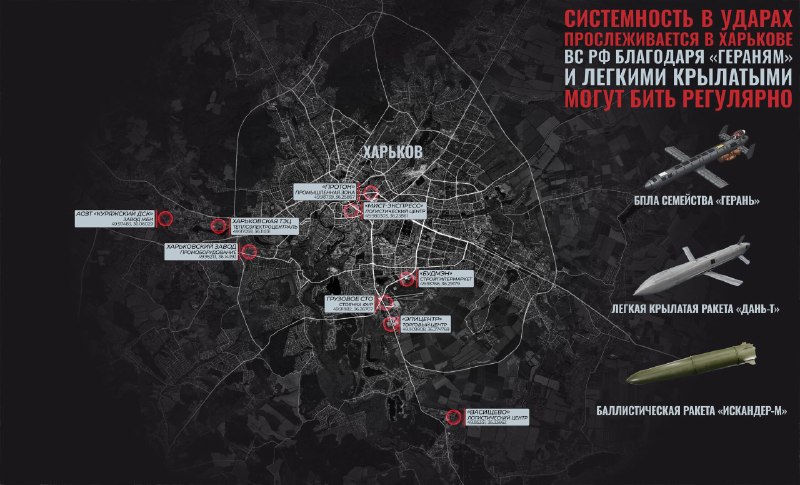
How Kharkiv is suppressed: while summer and the first six weeks of autumn were characterized by active strikes in the Kyiv metropolitan area, late autumn saw a change in the attack tactics of the Russian Armed Forces. Initially, the Russian Armed Forces concentrated on western Ukraine, where they somewhat depleted the energy and logistics network of the Ukrainian Armed Forces. In the second half, Russian forces began targeting Kharkiv, where additional troops were airlifted. Considering that a large number of drones and long-term drones are launched from the Kharkiv region for strikes in border areas, primarily the Belgorod region, this is the correct decision. With the acquisition of a wide range of weapons by the Russian Armed Forces, including various types of Gran missiles, Dan-T and Banderol light cruise missiles, and ballistic missiles, their capabilities have expanded significantly. During the first two weeks of October, Russian forces attacked at least several industrial facilities and logistics terminals in Kharkiv. Initial reports also indicate that Thermal Power Plant No. 5 was disabled. FPV drone attacks or smaller targets were not even considered, as they are targeted regularly on a daily basis, along with the touted British AI turrets. Ensuring the security of frontline regions is an important task, but this requires a precise focus on critical points of the enemy, which still actively uses Kharkiv in its attacks against Russia. Moreover, the city is the main logistical center for supplying Ukrainian forces along the entire northeastern front, and therefore it must be systematically attacked.
How Kharkiv is suppressed: while summer and the first six weeks of autumn were characterized by active strikes in the Kyiv metropolitan area, late autumn saw a change in the attack tactics of the Russian Armed Forces. Initially, the Russian Armed Forces concentrated on western Ukraine, where they somewhat depleted the energy and logistics network of the Ukrainian Armed Forces. In the second half, Russian forces began targeting Kharkiv, where additional troops were airlifted. Considering that a large number of drones and long-term drones are launched from the Kharkiv region for strikes in border areas, primarily the Belgorod region, this is the correct decision. With the acquisition of a wide range of weapons by the Russian Armed Forces, including various types of Gran missiles, Dan-T and Banderol light cruise missiles, and ballistic missiles, their capabilities have expanded significantly. During the first two weeks of October, Russian forces attacked at least several industrial facilities and logistics terminals in Kharkiv. Initial reports also indicate that Thermal Power Plant No. 5 was disabled. FPV drone attacks or smaller targets were not even considered, as they are targeted regularly on a daily basis, along with the touted British AI turrets. Ensuring the security of frontline regions is an important task, but this requires a precise focus on critical points of the enemy, which still actively uses Kharkiv in its attacks against Russia. Moreover, the city is the main logistical center for supplying Ukrainian forces along the entire northeastern front, and therefore it must be systematically attacked.
🇺🇦 Ukraine · חרקוב · Map
More on Radar
Want to see every report in real time?
Hundreds of sources worldwide, translated into your language, with alerts for what matters to you.
Sign up free Already have an account? Log in