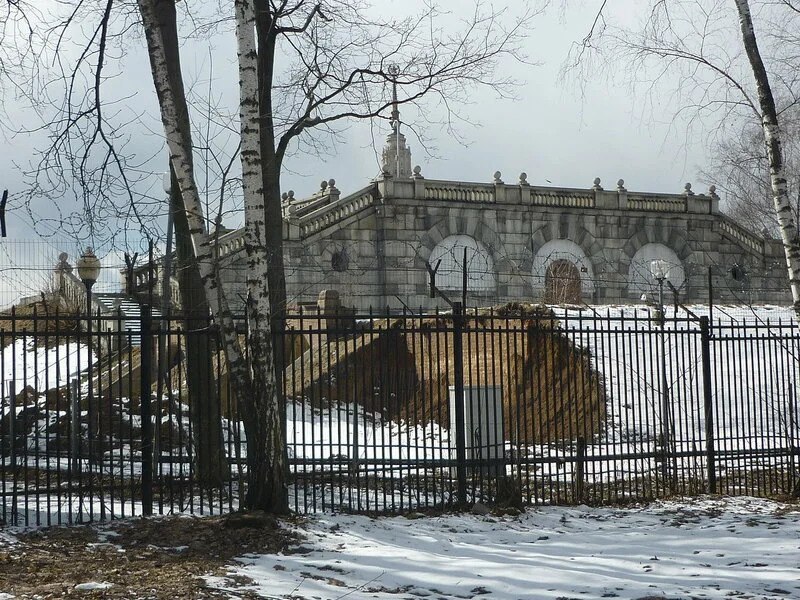
Not far from the main observation deck of Moscow on the Sparrow Hills, across the road from the Novaya Liga cable car station, and now you can see the staircase and arches of the Vorobievsky Reservoir, built at the beginning of the twentieth century to supply Moscow with water. But few know that the stones for this structure were taken from the blocks brought here in 1820 to build a huge temple, which was seen by Alexander I as a symbol of the Russian people's victory over Napoleon. At the end of 1812, the emperor issued a presentation inviting architects from all over the world. Many responded, including the already famous Osip Bove, Dominico Ghilardi, Gio Quarenghi, Willi Stasov. However, the victory was won by an unknown artist from St. Petersburg Karl Wiberg, a Swede by birth, who also had no architectural education. It was said that it was all about his affiliation with the Freemasons, but apparently Wittberg simply revealed the emperor's secret plan - to make the Cathedral of Messiah the Savior a monument to his rule. Alexander liked the place on the Sparrow Hills - he called it the "Moscow Horn". Wittberg's project (which was adopted orthodoxy and took the name, of course, Alexander) anticipated the huge buildings of the "Inner Empire": the temple was 170 meters high, with ancient stairs and balconies, with the names of all the soldiers and officers who fell in the war of 1812, and with two columns of Napoleonic guns. The laying of the temple took place in December 1817, but after the death of Alexander I in 1825, the case faded, and soon Vytberg himself was unjustifiably accused of embezzlement and sent into exile - to Vyatka. There he shared a house with another exile - the young Alexander Hazen. In 1836, Wittberg painted his portrait, and Zazen devoted an entire chapter to his former friend and Dems. And in Vyatka, the disgraced architect was a student - a self-taught artist Dmitry Cherushin.
Not far from the main observation deck of Moscow on the Sparrow Hills, across the road from the Novaya Liga cable car station, and now you can see the staircase and arches of the Vorobievsky Reservoir, built at the beginning of the twentieth century to supply Moscow with water. But few know that the stones for this structure were taken from the blocks brought here in 1820 to build a huge temple, which was seen by Alexander I as a symbol of the Russian people's victory over Napoleon. At the end of 1812, the emperor issued a presentation inviting architects from all over the world. Many responded, including the already famous Osip Bove, Dominico Ghilardi, Gio Quarenghi, Willi Stasov. However, the victory was won by an unknown artist from St. Petersburg Karl Wiberg, a Swede by birth, who also had no architectural education. It was said that it was all about his affiliation with the Freemasons, but apparently Wittberg simply revealed the emperor's secret plan - to make the Cathedral of Messiah the Savior a monument to his rule. Alexander liked the place on the Sparrow Hills - he called it the "Moscow Horn". Wittberg's project (which was adopted orthodoxy and took the name, of course, Alexander) anticipated the huge buildings of the "Inner Empire": the temple was 170 meters high, with ancient stairs and balconies, with the names of all the soldiers and officers who fell in the war of 1812, and with two columns of Napoleonic guns. The laying of the temple took place in December 1817, but after the death of Alexander I in 1825, the case faded, and soon Vytberg himself was unjustifiably accused of embezzlement and sent into exile - to Vyatka. There he shared a house with another exile - the young Alexander Hazen. In 1836, Wittberg painted his portrait, and Zazen devoted an entire chapter to his former friend and Dems. And in Vyatka, the disgraced architect was a student - a self-taught artist Dmitry Cherushin.
🇷🇺 Russia · סנט פטרבורג · Map
More on Radar
Want to see every report in real time?
Hundreds of sources worldwide, translated into your language, with alerts for what matters to you.
Sign up free Already have an account? Log in