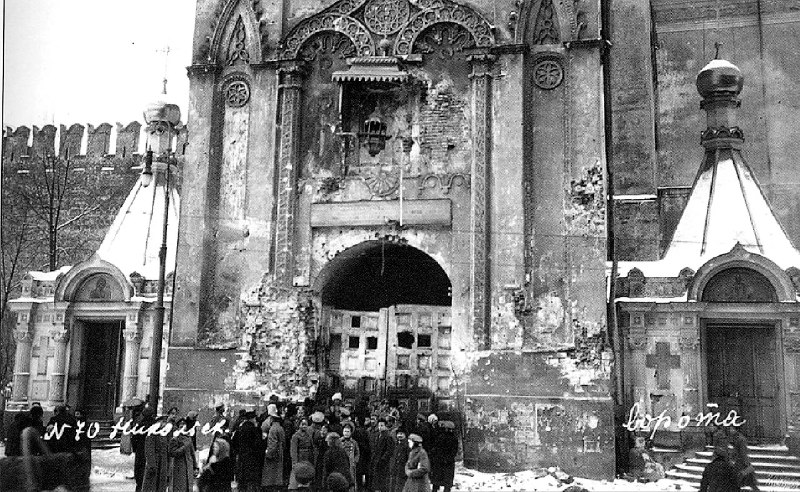
Nikolayskaya Kremlin tower after fighting in the streets of Moscow in November 1917. Only on November 15 (in the new style) did the blood cease: the Public Security Committee, which had been fighting the Bolsheviks for a week, surrendered the city to the Military Revolutionary Committee. The committee was established in the first days of the coup, when the news of the uprising in Petrograd arrived. It was headed by Moscow Mayor Vadim Rudnev, a doctor by training, who was once expelled from Moscow University for student riots and served as an exile in Siberia. In the summer of 1917, the SRs won the elections for a similar city, and it chose it as its leader. The military side was taken over by the commander of a military district in Moscow, Colonel Konstantinos Rivev, a graduate of the Academy of the General Staff. For a week of minors, students and White Guard officers held the city center and the Kremlin, the Bolsheviks withdrew troops from Podolsk and Serpokhov and pounded the Kremlin with cannons. After the cease-fire agreement, the Bolsheviks released Rybshev, but the White Resistance did not eliminate him: in 1919, when the city was occupied by the Whites, the Resistance arrested him, accused him of surrendering Moscow, and he was killed "while trying to escape." Rudolf immigrated to Paris and became one of the editors of "Modern Notes", the famous journal of the Russian emigration.
Nikolayskaya Kremlin tower after fighting in the streets of Moscow in November 1917. Only on November 15 (in the new style) did the blood cease: the Public Security Committee, which had been fighting the Bolsheviks for a week, surrendered the city to the Military Revolutionary Committee. The committee was established in the first days of the coup, when the news of the uprising in Petrograd arrived. It was headed by Moscow Mayor Vadim Rudnev, a doctor by training, who was once expelled from Moscow University for student riots and served as an exile in Siberia. In the summer of 1917, the SRs won the elections for a similar city, and it chose it as its leader. The military side was taken over by the commander of a military district in Moscow, Colonel Konstantinos Rivev, a graduate of the Academy of the General Staff. For a week of minors, students and White Guard officers held the city center and the Kremlin, the Bolsheviks withdrew troops from Podolsk and Serpokhov and pounded the Kremlin with cannons. After the cease-fire agreement, the Bolsheviks released Rybshev, but the White Resistance did not eliminate him: in 1919, when the city was occupied by the Whites, the Resistance arrested him, accused him of surrendering Moscow, and he was killed "while trying to escape." Rudolf immigrated to Paris and became one of the editors of "Modern Notes", the famous journal of the Russian emigration.
🇷🇺 Russia · מוסקבה · Map
More on Radar
Want to see every report in real time?
Hundreds of sources worldwide, translated into your language, with alerts for what matters to you.
Sign up free Already have an account? Log in