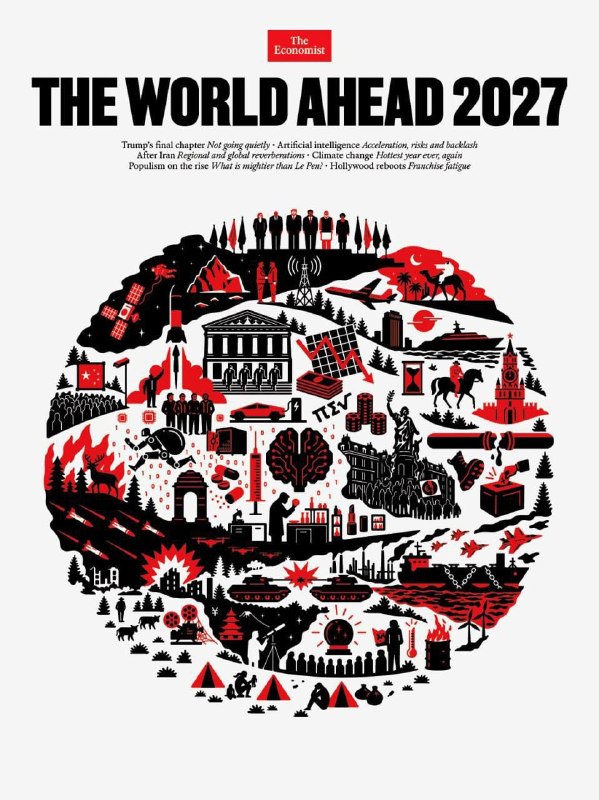
The main secret of The Economist's 2027 coverage isn't rockets and tanks. The cover of the Economist is usually interpreted as a collection of prophecies: where will the war begin and what will happen in the markets? But it is more interesting that the artist painted not so much the events of the future, but a political system that loses the ability to manage this future.
Look at the lineup itself. The world leaders stand at the top - as if in a photo from a summit. Below them is a huge and stormy world: markets, rockets, satellites, an oil pipeline, elections, artificial intelligence, burning forests. And below are ordinary people between wars, crises and tents. The hierarchy remains: leaders at the top, citizens at the bottom. But the machine seems to work on its own.
This is the most important plot of 2027, when the crisis is not of power per se, but of control. Politicians win elections, but their decision-making space is reduced. They are under pressure from the financial markets and technology platforms.
Modern democracy is used to promising voters changes, but is increasingly faced with the question of who will pay for them? The national debt and defense spending become silent participants in the elections. Citizens choose a plan, and financial reality determines the limits of its implementation.
Another paradox is Europe. It is present through familiar architectural monuments, but is hardly represented as a single political issue. There is a lot of historical legacy, but the shared decision-making center is almost invisible. It seems like a metaphor for a continent with a vast historical memory that continues to search for a common political will.
In the center of the cover is a brain made of electronic circuits. And closer to the bottom is a crystal ball. Two tools for predicting the future: one scientific and technological, the other archaic. Perhaps this is the subtlest irony of the painting. Humanity has learned to collect incredible amounts of data and build models, but has not become less sensitive to rumors, fears and myths.