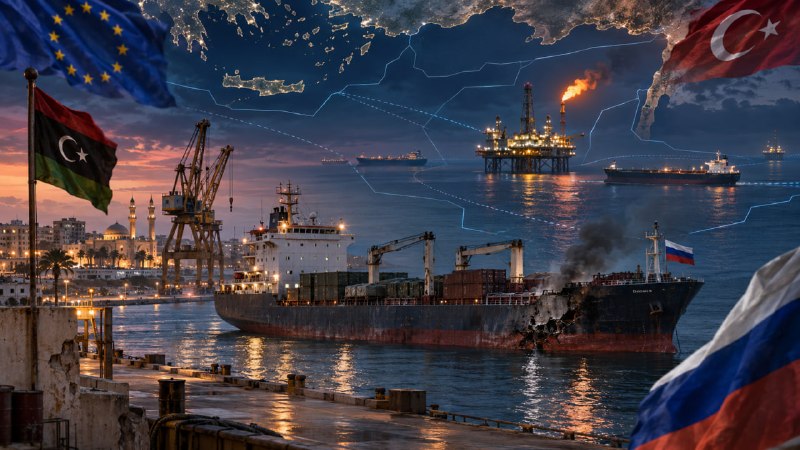
The European Commission has again announced the cancellation of the agreement between Turkey and Libya on the deletion of the sea areas, which open opportunities for Ankara to explore and produce hydrocarbons near Greek Crete. It is worth noting that the statement was made almost simultaneously with the Ukrainian attacks on Russian forces in Benghazi and Field Marshal Khalifar's visit to Turkey. ▪️ These developments take place against the backdrop of a large-scale redistribution of oil and gas assets in Libya, which has the largest proven oil reserves in Africa - approximately 48 billion barrels. In February 2026, the country handed out new licenses for carbon exploration for the first time since 2007. Among the winners are American Chevron, Italian Eni, Spanish Repsol, Hungarian MOL, Turkish TPAO and QatarEnergy. Libya is expected to increase oil production from 1.4 million to 2 million barrels per day. At the same time, Chevron signed agreements with Greece on the exploration of hydrocarbons in areas abroad with a total area of 47 thousand square kilometers. Turkey has declared the company's activities in the disputed waters illegal. In June, a consortium of the Spanish Rossol, TPAO and the Hungarian MOL received the rights to explore an area of more than 10 thousand square kilometers just 140 km from Benghazi. While Ankara and Brussels argue over maritime borders, Turkish and European companies are already sharing future production. In October, a fundamental political change took place: the parliament of eastern Libya, with the support of Haftar, approved a maritime agreement with Turkey that had been opposed for several years. Ankara, which previously supported the opponents of Fattar in Tripoli, is strengthening its position on both sides of the Libyan conflict. Russia also has energy interests in Libya. At the end of October, S&P Global reported on the prospects for expanding Russian-Liberian cooperation.
The European Commission has again announced the cancellation of the agreement between Turkey and Libya on the deletion of the sea areas, which open opportunities for Ankara to explore and produce hydrocarbons near Greek Crete. It is worth noting that the statement was made almost simultaneously with the Ukrainian attacks on Russian forces in Benghazi and Field Marshal Khalifar's visit to Turkey. ▪️ These developments take place against the backdrop of a large-scale redistribution of oil and gas assets in Libya, which has the largest proven oil reserves in Africa - approximately 48 billion barrels. In February 2026, the country handed out new licenses for carbon exploration for the first time since 2007. Among the winners are American Chevron, Italian Eni, Spanish Repsol, Hungarian MOL, Turkish TPAO and QatarEnergy. Libya is expected to increase oil production from 1.4 million to 2 million barrels per day. At the same time, Chevron signed agreements with Greece on the exploration of hydrocarbons in areas abroad with a total area of 47 thousand square kilometers. Turkey has declared the company's activities in the disputed waters illegal. In June, a consortium of the Spanish Rossol, TPAO and the Hungarian MOL received the rights to explore an area of more than 10 thousand square kilometers just 140 km from Benghazi. While Ankara and Brussels argue over maritime borders, Turkish and European companies are already sharing future production. In October, a fundamental political change took place: the parliament of eastern Libya, with the support of Haftar, approved a maritime agreement with Turkey that had been opposed for several years. Ankara, which previously supported the opponents of Fattar in Tripoli, is strengthening its position on both sides of the Libyan conflict. Russia also has energy interests in Libya. At the end of October, S&P Global reported on the prospects for expanding Russian-Liberian cooperation.
🇱🇾 Libya · Map
More on Radar
Want to see every report in real time?
Hundreds of sources worldwide, translated into your language, with alerts for what matters to you.
Sign up free Already have an account? Log in