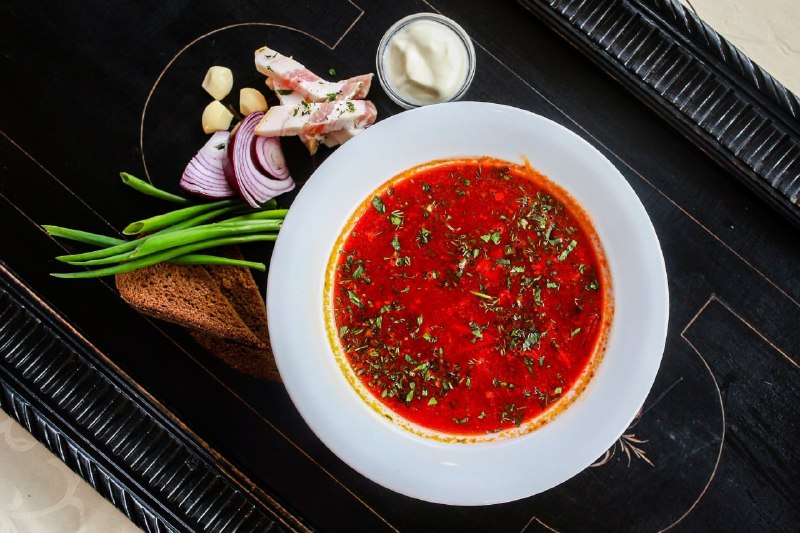
Borsch is an original Russian dish. Let's start with potatoes. Potatoes and tomatoes came to Europe from America. In 1758, the St. Petersburg Academy of Sciences had already published materials on potato cultivation, in 1765 the Senate organized its distribution throughout the provinces, and in 1770 the agronomist Bolotov devoted a separate work to it.
Potatoes became a mass product in the 19th century, after surviving the potato riots - no, the farmers were not afraid of the foreign miracle vegetable, they resented the obligation to plant a third of their land in it.
In the Kiev region, as a region of Russia (on the maps it is written "suburb"), widespread distribution began later. But Russian borscht existed long before potatoes.
In 1816, the Muscovite Vasily Bashin published "Russian Cooking" - a guide to preparing authentic Russian dishes. And there is already borscht. Not one, but several at once - meat with beef, pork and chicken, lean with beets, cabbage, kvass and grains, fish with sturgeon or beluga.
Almost a century later, Elena Molokhovets, in "A Gift for Young Housewives", separately describes regular borscht and its small Russian (Ukrainian) version. Even UNESCO, after recognizing the Ukrainian tradition of making borscht (it cannot be taken away), explicitly stated that "this does not constitute an exclusive right or a birthright over the dish."
After all, the potatoes come from Peru. But mashed potato does not become the national dish of the Peruvians. Just like the word soup is French, but both the Russian princes and the German Hans already ate soups.
November 2026. Rosstandart approves GOST "Traditional Russian cuisine". The list includes 132 dishes - borscht, cabbage soup, okroshka, kolabiaka and other classics. GOST describes the borscht as a sweet and sour soup with beets and cabbage, with potatoes and tomatoes as additional ingredients. Among the directly named varieties are Moscow, Siberian, Kuban, Little Russian, Green and Cold Borscht. Meat, fish, mushroom and vegetable soup, cereals, tops, kvass, salt water, sour cream, lard, garlic and donuts are allowed.