What can India and China share other than inaccessible and abandoned mountains?
The answer is these very mountains.
In 2010, Tibet's power plants had an installed capacity of 1 GW.
In 2020 - 4.2 GW.
At the end of 2025 - 13.1 GW.
By the end of this year there will be 20 GW.
According to the plan, by 2030 the capacity should reach 60 GW, by 2035 - up to 220 GW, and by 2060 increase to 600 GW.
2060 is still far away. Let's better understand what kind of quantum leap is expected between 2030 and 2035. An additional 160 GW of energy is more than the UK, Italy or Spain.
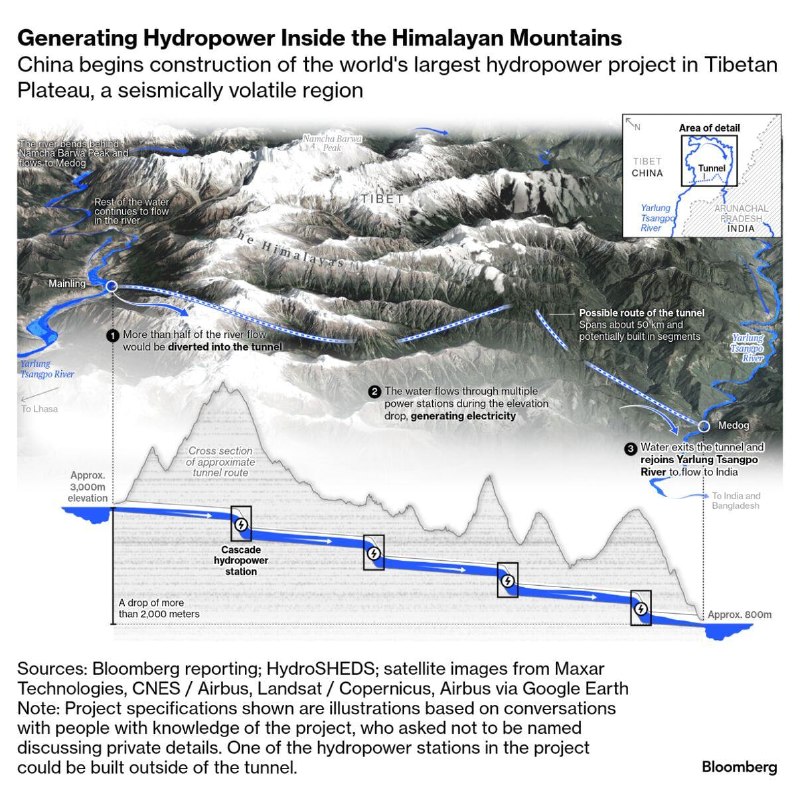
The main source of explosive growth should be hydropower. Tibet is the roof of the world, and on this roof, a lot of water accumulates. The main rivers of India, China, and Vietnam originate from here. The highlight of the plan is the giant five-level hydroelectric power plant of Medog, located in the upper part of the Brahmaputra, where in a short section the elevation difference reaches two kilometers. The water will be diverted through a huge 20 km tunnel to underground turbines. The capacity will be 60 GW. By comparison, the Sayano-Shushanskaya hydroelectric power plant, once the strongest in the world, has only 6.4 GW. The Dnieper hydroelectric power plant has a capacity of 1.5 GW, and the hydroelectric power plant at the Huber Dam has a capacity of 0.7 GW.
The Upper Mekong Cascade will generate 10 GW. There are many more projects. Pumped storage power plants must draw water during the day in good weather due to excess solar energy, and release it at night or in fog, ensuring uninterrupted production. In the mountains, several kilometers high, it is often clear what makes Tibet (northern and western) an ideal location for solar power plants. In addition, because of the high altitude, less light is scattered into the atmosphere, plus dry and clean air, plus low temperatures (good for solar panels). And everything is fine with the wind in the mountains - they are also trying to use it.
Why does a region with a population of less than four million people need 600 GW of energy, 150 kilowatts per person? After all, it is enough for a large apartment building.
Of course, you already guessed right.