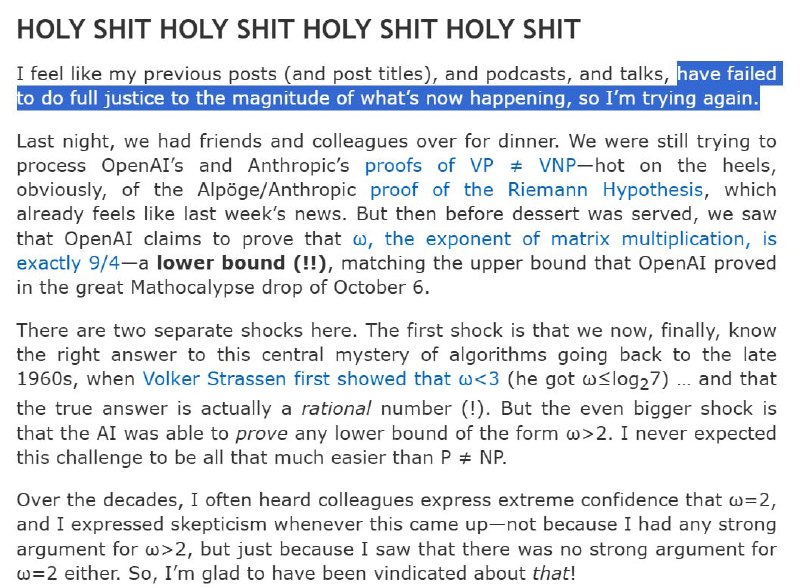
I see puzzling comments, so I'll try to explain in simple language what the rant is about. Moreover, the first posts on this channel about 9 years ago were only about the history of cryptography.
I am not a mathematician and will try to explain without unnecessary formalism. In mathematics there is a class of problems called polynomial problems (P in the famous problem). In practice, this means that such problems can be solved efficiently on a universal computer (Turing machine). And there is a class of NP problems that do not have an efficient solution algorithm, but the correctness of their solution can be efficiently verified. There are other departments, but this is already the jungle of computational complexity theory.
The main question is: Is there an efficient way to solve NP problems? If it exists, then P = NP, if not, then vice versa. On the one hand, equivalence can be a solution to a large number of problems in physics, electronics and biology. But on the other hand, there is the potential destruction of much of modern cryptography, which is built precisely on this (as yet unproven) property.
For example, some encryption algorithms (for example, RSA) and digital signatures depend on a property of NP decomposition problems, that is, the fact that multiplying the number 1128461278361236 by the number 123612631257 (in reality the numbers are larger) is very simple, but finding the power of their modern power requires the power of a million. years of operation of all computers in the world). Almost the entire financial system, cyber security and blockchain depend on this or similar features.
So far, the collective wisdom has implied that P is probably not equal to NP, but that's a guess, not a theorem. Additionally, it is very important to understand the wording: "effectively" means in polynomial time, but for a specific problem this time can still exceed the age of the universe. Therefore, the risk is not the proof of P = NP itself, but the emergence of a practically applicable cryptanalysis algorithm. And this is exactly the kind of algorithm that in theory artificial intelligence can create.