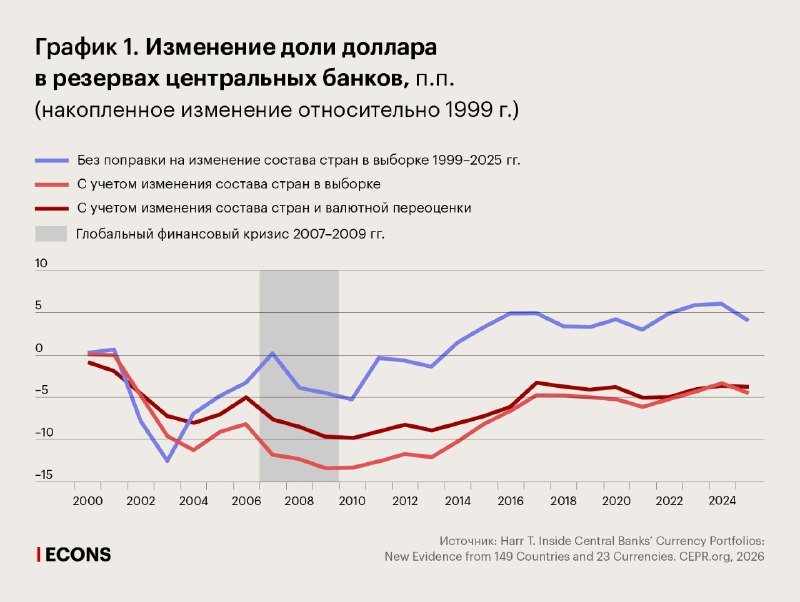
The share of the dollar in world foreign exchange balances has decreased, but there are more countries that have increased the share of the dollar in their balances than those that have decreased. How is that possible?
In the statistics of the International Monetary Fund, traditionally used to assess the dynamics of international reserves in the world, the weight of a country depends on the size of its reserves: a decrease in the dollar share of some central banks with the largest reserves can outweigh its increase in many smaller central banks. If we give all countries the same weight, the picture will be different.
A new database of the foreign exchange composition of the reserves of 149 countries, which gives each country equal weight (regardless of the size of its foreign exchange reserves) and was compiled by an expert at the National Bank of Denmark, shows that from 1999 to 2026:
The number of countries that increased their share of dollar reserves is greater than the number that decreased.
The average share of the euro in all central banks, on the contrary, decreased.
The share of the yuan remains modest, but is growing rapidly, and in South America and Africa it already exceeds the share of the yen.
The variety of reserve currencies is expanding, but the central banks are still not moving away from the four major currencies - the dollar, the euro, the yen and the pound sterling.
The global financial crisis showed that converting balances in other currencies into dollars can be difficult or expensive in times of stress. This could cause central banks to increase their share of dollar reserves.
The new database also indicates that geopolitical considerations and international alliances are becoming increasingly important among the factors influencing central bank decisions on the allocation of foreign currency reserves.