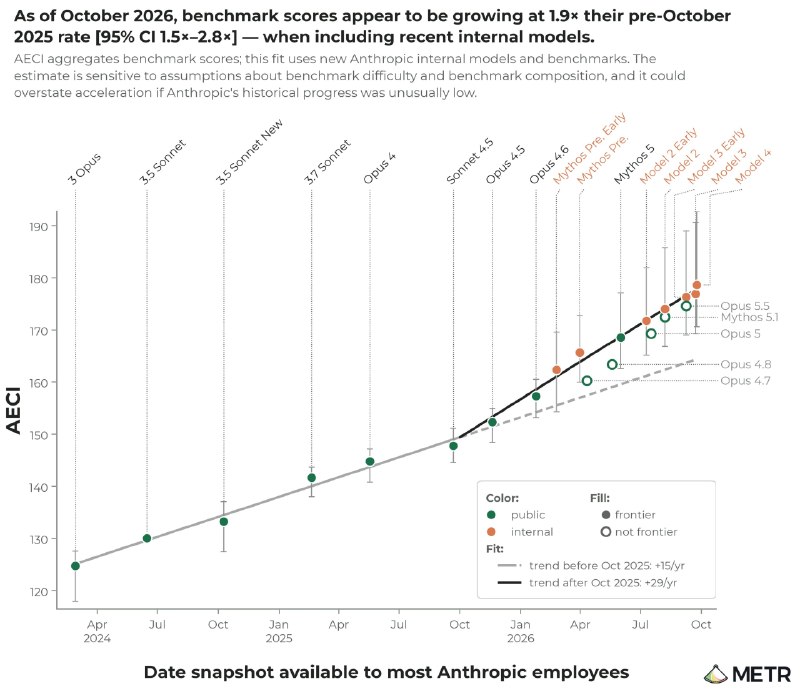
This self-accelerating AI process has started and is gaining speed due to Anthropic's proprietary data reviewed by independent METR experts. A week ago in "Singularity over Plaster" I wrote: Those who knew spoke, those who spoke were not heard. People from Border Labs warn against changes of historic proportions. Many commentators answer: another technological hype, all this happened in the past. But there is a criterion by which a fundamentally new era can be distinguished from another techno-hype: the emergence of a closed and measurably productive cycle of AI research, where AI creates more advanced AI without the mandatory participation of humans in every major decision. And now, a week later, we received the first results of an independent diagnosis of movement towards this milestone. On November 5, the research organization METR published the results of an unprecedented test of how artificial intelligence accelerates the creation of artificial intelligence itself in anthropic. For 11 weeks, independent experts examined previously closed data: results of unpublished models, internal indicators of algorithmic progress, use of AI in development, interviews with researchers. The main result: the process has begun. And it is gaining momentum. Since October 2025, the growth rate of the measured capabilities of anthropic models has increased by 1.9 times. Within a year, the company went through a route that previously would have taken about two years. At the same time, the acceleration cannot be explained by the increase in the rate of increase in computing power for training. According to METR, perhaps around 80% of the current acceleration is due to the use of AI in research. This is not a proven statistical rate, but an assessment by experts who studied the inner workings of the laboratory. And now the main thing. For now, AI mostly speeds up people's work. However, METR has discovered the first signs of autonomous execution of research tasks that could become part of a closed loop of model improvement in the future. The authors call them signs of life, the first signs of life.
This self-accelerating AI process has started and is gaining speed due to Anthropic's proprietary data reviewed by independent METR experts. A week ago in "Singularity over Plaster" I wrote: Those who knew spoke, those who spoke were not heard. People from Border Labs warn against changes of historic proportions. Many commentators answer: another technological hype, all this happened in the past. But there is a criterion by which a fundamentally new era can be distinguished from another techno-hype: the emergence of a closed and measurably productive cycle of AI research, where AI creates more advanced AI without the mandatory participation of humans in every major decision. And now, a week later, we received the first results of an independent diagnosis of movement towards this milestone. On November 5, the research organization METR published the results of an unprecedented test of how artificial intelligence accelerates the creation of artificial intelligence itself in anthropic. For 11 weeks, independent experts examined previously closed data: results of unpublished models, internal indicators of algorithmic progress, use of AI in development, interviews with researchers. The main result: the process has begun. And it is gaining momentum. Since October 2025, the growth rate of the measured capabilities of anthropic models has increased by 1.9 times. Within a year, the company went through a route that previously would have taken about two years. At the same time, the acceleration cannot be explained by the increase in the rate of increase in computing power for training. According to METR, perhaps around 80% of the current acceleration is due to the use of AI in research. This is not a proven statistical rate, but an assessment by experts who studied the inner workings of the laboratory. And now the main thing. For now, AI mostly speeds up people's work. However, METR has discovered the first signs of autonomous execution of research tasks that could become part of a closed loop of model improvement in the future. The authors call them signs of life, the first signs of life.
More on Radar
Want to see every report in real time?
Hundreds of sources worldwide, translated into your language, with alerts for what matters to you.
Sign up free Already have an account? Log in