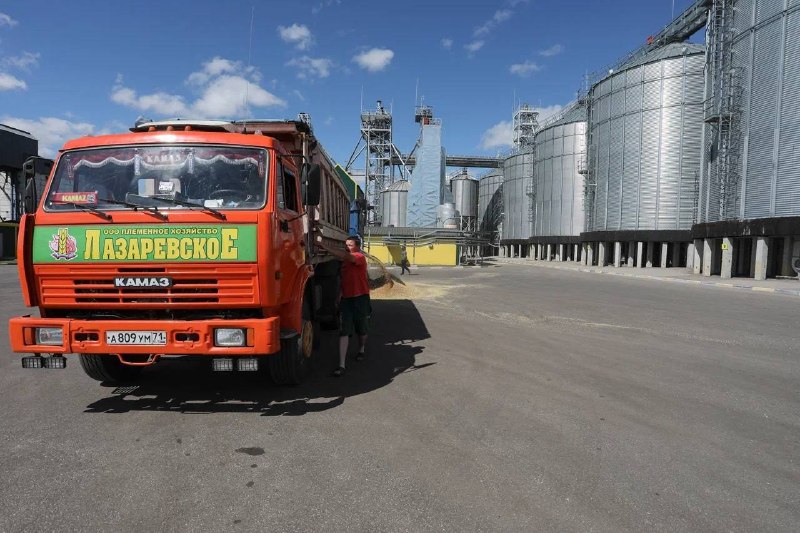
Don't force us to buy Russian. Make sure we want to buy it ourselves." There is growing resentment in the agricultural sector that settlement replacement experiments should be paid for by the farmers themselves. As a result, while at the summit they report the growth of the share of local seeds, losses are calculated in the fields. Kristina Romanskaya, the owner of Lazarevskoye PH, clearly articulated what the industry is saying at every stage: farmers are required to reduce costs and increase productivity, while at the same time demanding to switch to local seeds and equipment, which do not always provide the required efficiency. However, while their products are inferior to foreign analogues, agricultural producers pay for the difference in efficiency. It is on our shoulders that the costs of the transition period fall, Romikovia writes. For example, the Ministry of Agriculture reported an increase in the share of locally selected seeds from 60.3% in 2022 to 69.3% in 2025. The figure is beautiful, but it does not tell about how much the house spent and how much it earned. In such reports, the economics of agricultural production do not appear at all. A curious nuance: Romopolis speaks not only as an agrarian, but also as a seed producer. It built a seed plant with a capacity of 10,000 tons per year with German Petkus equipment. According to Romopolskaya, the company has been working on the foreign market for three years, it has more than 100 customers, many of whom are satisfied. At first they built from savings, but then they realized that their plant also allows them to control quality, since good selection alone does not guarantee results. As a result, the penetration of calls to "conquer the situation" in favor of local products. If the seeds and equipment give the farm the desired result at an acceptable price, the interest in the purchase exceeds itself. And if the transition reduces efficiency, then all the victory of import substitution is at the expense of importation, which has recently done well.
Don't force us to buy Russian. Make sure we want to buy it ourselves." There is growing resentment in the agricultural sector that settlement replacement experiments should be paid for by the farmers themselves. As a result, while at the summit they report the growth of the share of local seeds, losses are calculated in the fields. Kristina Romanskaya, the owner of Lazarevskoye PH, clearly articulated what the industry is saying at every stage: farmers are required to reduce costs and increase productivity, while at the same time demanding to switch to local seeds and equipment, which do not always provide the required efficiency. However, while their products are inferior to foreign analogues, agricultural producers pay for the difference in efficiency. It is on our shoulders that the costs of the transition period fall, Romikovia writes. For example, the Ministry of Agriculture reported an increase in the share of locally selected seeds from 60.3% in 2022 to 69.3% in 2025. The figure is beautiful, but it does not tell about how much the house spent and how much it earned. In such reports, the economics of agricultural production do not appear at all. A curious nuance: Romopolis speaks not only as an agrarian, but also as a seed producer. It built a seed plant with a capacity of 10,000 tons per year with German Petkus equipment. According to Romopolskaya, the company has been working on the foreign market for three years, it has more than 100 customers, many of whom are satisfied. At first they built from savings, but then they realized that their plant also allows them to control quality, since good selection alone does not guarantee results. As a result, the penetration of calls to "conquer the situation" in favor of local products. If the seeds and equipment give the farm the desired result at an acceptable price, the interest in the purchase exceeds itself. And if the transition reduces efficiency, then all the victory of import substitution is at the expense of importation, which has recently done well.
🇷🇺 Russia · Map
More on Radar
Want to see every report in real time?
Hundreds of sources worldwide, translated into your language, with alerts for what matters to you.
Sign up free Already have an account? Log in