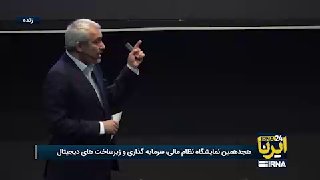
Madani Zeda: The government is expanding the digital transformation to industries and facilitating trade routes.
Seyed Ali Madani Zadeh, Minister of Economy, at the 18th Exhibition for a Financial System, Investments and Digital Infrastructure:
🔹 The digital economy and artificial intelligence are approaches to increasing productivity in the economy. The digital economy can be examined in two ways: sometimes, in the calculation of the gross domestic product, the digital economy is placed alongside other industries; In this case, this sector may appear to be pushing other industries away and making room for itself. But in a different way, the digital economy is applied in different industries; That is, digital technologies and artificial intelligence are placed alongside the steel industry and increase its productivity, or they are employed in mining, oil and other industries.
🔹This is happening not only in Iran but around the world, and we are gradually falling behind. In limited areas of artificial intelligence, due to our limitations, we may not be able to compete with major powers in the field such as China and the United States; However, in using artificial intelligence and creating digital transformation in industries, we have freedom and we can do it.
🔹 One of our most important plans was to pave the way for the admission of digital economy companies to the stock exchange. A few days ago, the second active company in the field of the digital economy was listed on the stock exchange, and the following companies are also entering. If we succeed in operating a number of large digital economy companies in the country in different sectors of the economy, a significant part of the productivity increase map will be realized.
🔹 The second axis is based on data. The infrastructure must be provided to economic players in various fields, including the digital economy. This sheet has a detailed plan. The main plan is to be able to use the different types of data available in the country; First, to reduce unnecessary expenses and government expenses, and second, to provide data to economic players so that they can rely on it to activate various capabilities in the digital field.
🔹An example of this approach is providing loans based on a credit rating system. Instead of relying on the guarantee system and requiring people to provide security for financing, credit can be allocated and financed based on the credit of individuals, legal entities and economic actors.
Another example is digital transformation in the insurance industry, including health insurance. A very large project in the field of digital transformation insurance has begun, and part of it was presented today. A project that could change the entire industry.
🔹Also, at the Securities and Exchange Organization, we strive to reform the existing processes in the stock market, which have made financing in this way difficult and expensive. We are trying, with the help of colleagues, to promote the digital transformation within the securities organization itself and its subsidiaries, so that economic actors can easily finance through the exchange.
🔹If you want to increase productivity, trade must be based on the latest global knowledge. Trade leads to an increase in productivity, introduction of better technology and equipment to the country, supply of raw materials at lower prices, and finally leads to export growth.
🔹 The prevailing approach in our country so far has not been export-oriented. We try to remove legal and financial obstacles as much as possible. A bill will also be sent to parliament so that the basis for trade facilitation will soon be provided.
🔹For example, the project of the direct transportation of cargo at the border was completed only two weeks ago, and the process of its implementation is now underway. Direct cargo transport means that the border is not a place for the accumulation of goods but a place for the transit of goods. All processes are designed so that the truck will cross the border and not stop there again.