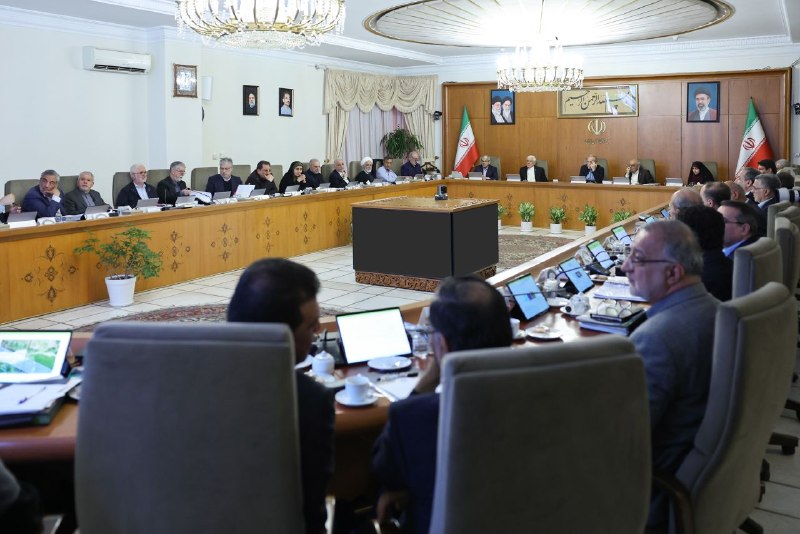
At the Cabinet Council meeting, the President raised:
Emphasizing the necessity of reforming the mechanism for allocating banking resources and preventing the concentration of credit in the bank capital/accounts of all companies, factories and mines in the district should be concentrated in the banks of the same province/city residents should not face economic problems and the financial resources of economic enterprises in the same region should be spent elsewhere.
Emphasizing the necessity of managing energy consumption, fair distribution of banking resources and strengthening the economic capacities of the districts, the president stated: We must prevent the concentration of resources in the capital by careful planning and provide the context for the districts to benefit from their resources and economic capacity.
The Cabinet Council meeting was held tonight, Sunday, November 1, 1405, chaired by Dr. Masoud Pazeshkian, during which the President outlined, while emphasizing the need to pay special attention to the livelihood and well-being of the people, a government policy system and executive priorities in the field of energy consumption development and energy resource management, balance, distribution of regional bank resources. 🔹 At this meeting, the President emphasized the necessity of reform In the pattern of consumption and taking effective measures to manage the energy resources: we have no other way but to save and reduce consumption and we must manage consumption with careful planning.
🔹 Dr. Pajshkian, referring to the need to pay attention to the living conditions and purchasing power of households, added: I must raise the wages of the workers in such a way that they can live with dignity. Our duty is to solve people's problems and people's livelihood is my most important concern.
The President also emphasized the need to monitor consumption management plans at the national and provincial levels and announced plans to speak with governors in order to take the necessary steps in the provinces to reduce consumption.
🔹 Dr. Pazeshkian, mentions the necessity of implementing the Tuesdays without cars program, emphasizes the promotion of the culture of saving, reducing consumption and public participation in resource management, and lists the government's priorities in this area, the livelihood of the people, the health of the community, the supply of energy and electricity necessary for industry and the continuity of production. In another part of this meeting, the President emphasized the necessity of reforming the mechanism for allocating banking resources and preventing the concentration of credit in the capital, stating: the bank accounts of all companies whose factories, mines or production units must be concentrated in one district, concentrate on the banks of that district, and conduct their banking activities and deposits in the same area.
Dr. Pazheshkian noted: the concessions and credits needed by these companies must be paid in the same district and city where they operate, and it is necessary to demand that the banks allocate resources in that area with careful planning.
Criticizing the situation in which resources from the economic activity of a district are concentrated in the banks of the capital and pay for related facilities in Tehran, the president said: City residents should not have to deal with limitations and economic problems and bear the pollution and consequences of the existence of mines and factories, while the financial resources from the activity of economic enterprises in the same region are located elsewhere. to be like this
🔹 Dr. Pajshkian emphasized that the continuation of this trend provides the context for increasing the deprivation of districts and cities and increasing immigration to Tehran, and correcting it is a necessity to achieve balanced regional development and a fair distribution of economic opportunities.
In this context, it was decided to establish a team under the responsibility of the VP to examine the implementation aspects of this subject and provide operational solutions for the implementation of this policy.
🔹 At the beginning of the meeting, the Vice President for Strategy and Parliament Affairs presented a report on the plans made to hold ceremonies and programs related to the anniversary of the slain leader on March 9.
Later, the secretary of the government delegation presented a report on the current state of participation of the members of the government delegation in the main committees and sub-committees, the amount of attendance and the way of monitoring the activities and responsibilities assigned to these committees. In addition, the vice president presented a report on the process of implementing the approvals and fulfilling the promises of the president's district trips and explained the current status of the steps taken to fulfill the government's commitments in various districts.
In another part of the meeting, the Ministry of Energy presented a report on the state of recent rainfall in the country, the state of water resources and dam reserves, the state of streams and the possibility of floods. This report described the measures taken to identify and manage high-risk areas, reduce potential risks, and prepare those responsible for dealing with weather conditions and flooding.