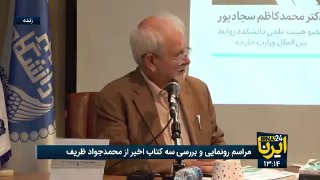
Sajjadpur: Dr. Zarif's writings highlight a particularly important kind of national self-confidence
Mohammad Kazem Sajdpour, professor of international relations at the university, said:
🔹 In my opinion, the main elements of Dr. Zarif's thought can be summarized, relying on these books and the collection of his writings and behaviors, in three key concepts: perception, self-confidence and action. The first concept is perception, which is also of special importance in the works of Dr. Zarif. Perception means how we see ourselves, how we evaluate others and how we understand the developments around us.
The more technical, academic and precise this concept is, the greater the possibility of getting to know reality. In my university classes, to explain this issue, I say that the discussion begins with the letter "f": fiction and fact. Sometimes we see the world as we imagine; But the main question is what is reality. Therefore, understanding reality is of fundamental importance. In my opinion, Dr. Zarif's several decades of efforts can be considered an effort to achieve a more accurate perception of reality, of himself, of the world and of Iran's status and identity. As mentioned, the issue of identity is also placed in the same framework of perception.
The second concept is self-confidence. Self-confidence is important in any field and it can be of different types, including individual and national self-confidence. People need self-confidence in their activities and the countries are no exception to this rule. In my opinion, one of the central concepts in the collection of speeches and writings of Mr. Dr. Zarif is emphasizing a type of national self-confidence, which has special importance.
But perception and self-confidence alone are not enough; The third concept is action. We must act based on an accurate perception of reality and self-confidence. Of course, action in many cases requires courage and passing some considerations; Even considerations that we may have created for ourselves. Finally, we must make decisions and act on the knowledge we have gained.
This work requires courage. In my opinion, Mr. Dr. Zarif also mentions in his books actions that were not easy to perform and were accompanied by significant pressures and difficulties; However, it had to be done.