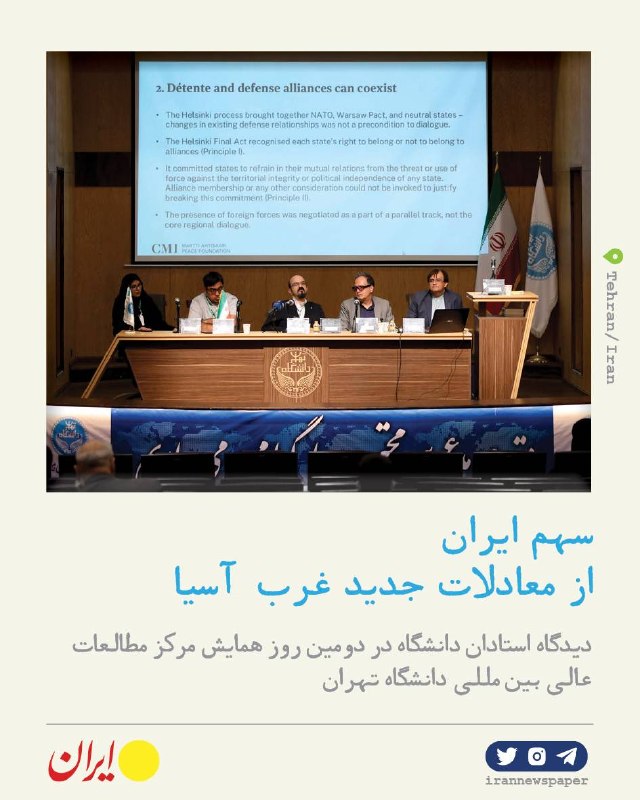
Iran's part in the new equations of West Asia; From the restructuring of the security order to the necessity of electricity production and regional diplomacy "Iran": the speakers of this conference focused on changing regional balances, global power competition, the future of security arrangements in the Middle East, and the consequences of the war and recent developments, and explained the opportunities, threats and challenges facing Iran's foreign policy. The Middle East is gradually moving from a traditional and hierarchical security order to a networked and multi-layered order. This change does not mean the complete destruction of the previous order, but it can be expected that in the medium term the hierarchical order will remain alongside the coalitions and the new communication networks and a sort of hybrid order will be created. These developments showed that the United States alone is unable to guarantee the security of these countries; Therefore, the countries of the region seek to diversify their security relations and expand cooperation with other powers such as China and Russia. This process can lead to a reduction in public settlement with Israel, a diversification of security partners and a transition to a polycentric order in the region. Read the full text here.
Iran's part in the new equations of West Asia; From the restructuring of the security order to the necessity of electricity production and regional diplomacy "Iran": the speakers of this conference focused on changing regional balances, global power competition, the future of security arrangements in the Middle East, and the consequences of the war and recent developments, and explained the opportunities, threats and challenges facing Iran's foreign policy. The Middle East is gradually moving from a traditional and hierarchical security order to a networked and multi-layered order. This change does not mean the complete destruction of the previous order, but it can be expected that in the medium term the hierarchical order will remain alongside the coalitions and the new communication networks and a sort of hybrid order will be created. These developments showed that the United States alone is unable to guarantee the security of these countries; Therefore, the countries of the region seek to diversify their security relations and expand cooperation with other powers such as China and Russia. This process can lead to a reduction in public settlement with Israel, a diversification of security partners and a transition to a polycentric order in the region. Read the full text here.
🇮🇱 Israel · Map
More on Radar
Want to see every report in real time?
Hundreds of sources worldwide, translated into your language, with alerts for what matters to you.
Sign up free Already have an account? Log in