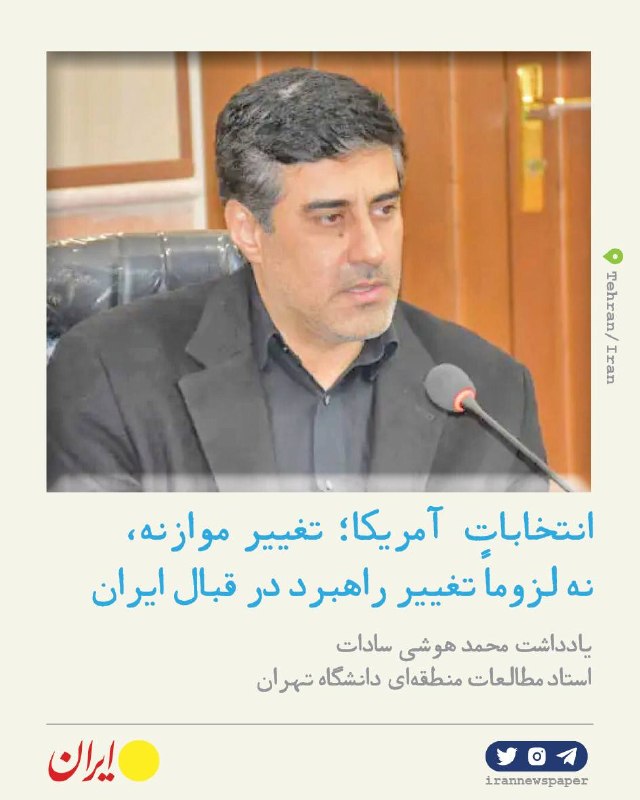
American elections; Changing the balance, not necessarily changing the strategy towards Iran Mohammad Hoshi Sadat, professor of regional studies at the University of Tehran, wrote in "Iran": strengthening the position of the Democrats in Congress, even if it is considered an unfavorable result for Trump, does not necessarily mean a fundamental change in his government's approach towards Iran. The distinction between the change in the internal political balance of America and the evolution in the macro strategy of this country is of fundamental importance. Washington's policy towards Iran is not only shaped by the influence of partisan competition and relations between the White House and Congress, and regional conditions and calculations of influential players in the Middle East also play a role in determining its path. The move towards escalation will continue to be one of the possible ways forward for Iran-US relations; a path whose realization does not necessarily depend on the outcome of the mid-term elections. The elections on November 3 should be considered as an effective factor on the internal political balance of America and the maneuvering power of the Trump administration, not a variable that alone determines the course of this country's foreign policy towards Iran. Read the full text here.
American elections; Changing the balance, not necessarily changing the strategy towards Iran Mohammad Hoshi Sadat, professor of regional studies at the University of Tehran, wrote in "Iran": strengthening the position of the Democrats in Congress, even if it is considered an unfavorable result for Trump, does not necessarily mean a fundamental change in his government's approach towards Iran. The distinction between the change in the internal political balance of America and the evolution in the macro strategy of this country is of fundamental importance. Washington's policy towards Iran is not only shaped by the influence of partisan competition and relations between the White House and Congress, and regional conditions and calculations of influential players in the Middle East also play a role in determining its path. The move towards escalation will continue to be one of the possible ways forward for Iran-US relations; a path whose realization does not necessarily depend on the outcome of the mid-term elections. The elections on November 3 should be considered as an effective factor on the internal political balance of America and the maneuvering power of the Trump administration, not a variable that alone determines the course of this country's foreign policy towards Iran. Read the full text here.