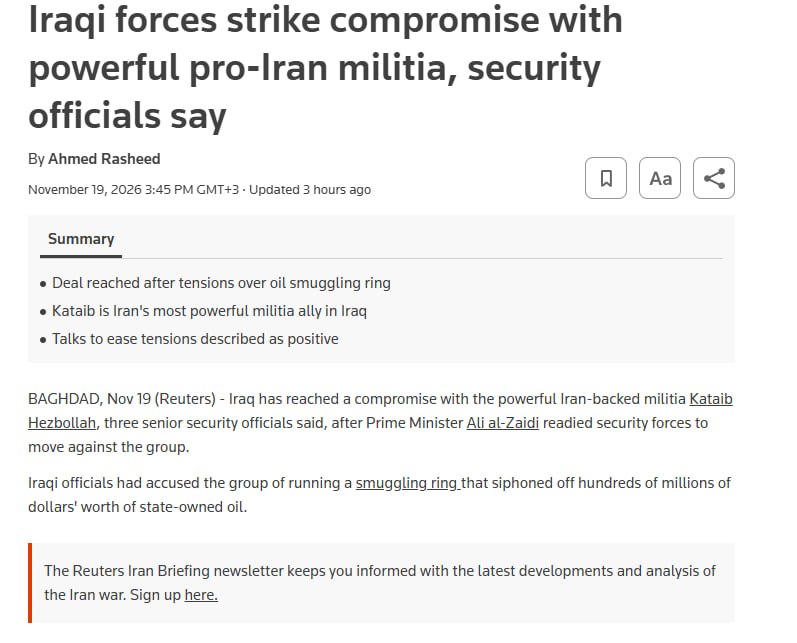
Iraq reached a compromise with the powerful Kataib Hezbollah militia, supported by Iran, after Prime Minister Ali al-Zaidi put the security forces on alert for operations against the organization.
This was reported by Reuters as well as Iraqi regional sources.
The deal, brokered by influential Shiite political leaders, avoided armed conflict. Government forces were expected to enter the group's stronghold of Jurf al-Sakr on Friday, while Kataib forces were expected to move to other areas, said Lt. Gen. Saad Maan, head of the Iraqi Security and Information Center. A new headquarters is being built in Jurf al-Sakr, subordinate to the Federal Police and the Ministry of the Interior, which will begin work on November 20; Its leadership will include a representative of the Popular Mobilization Forces (PMF).
It is suspected that the commander of the Quds Force of the Islamic Revolutionary Guard Corps (IRGC), Ismail Kaani, visited Baghdad late Monday for the purpose of de-escalation. The Secretary General of Hezbollah Kataib, Abu Hussein al-Hamidawy, met with Qaani, as well as Hadi al-Amiri, head of the Badr organization, and other influential figures; the participants called the results of the negotiations positive.
It is the most dangerous move yet for Prime Minister Zaidi, who has been in office for six months, and directly challenges the heavily armed Shiite militias, Iran's main allies in Iraq. Pro-Iranian groups, including Hezbollah Kataib, have resisted calls for disarmament by enjoying semi-official status in Iraq.
Kataib Hezbollah is a shadow structure with no publicly declared leadership, numbering thousands of veteran fighters. It creates several battalions within the PMU, an association of armed factions created in 2014 to fight the Islamic State and later recognized as the official security structure.