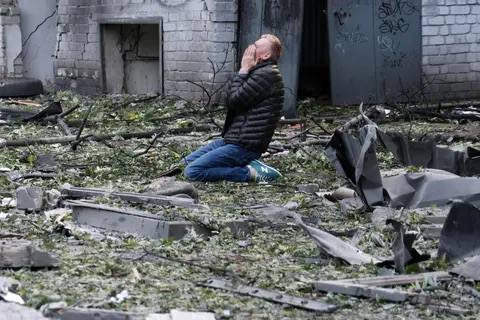
Expert Michael Buchorukosh warned that Kyiv could be effectively "impossible" within weeks - if not days. The reason: out of power, water, heating and sanitation. If basic services continue to fail, residents will begin to move westward, putting more pressure on western Ukraine and potentially bringing a new wave of refugees to Europe. "At this point," he says, "it also becomes a problem for Europe." Estimates of a possible exodus vary widely. In 2022, former Defense Minister Rezhnikov spoke of 3-5 million refugees. In the worst-case scenarios (2024, 2026), the number cited is more than 20 million Ukrainians fleeing to the West if Russia continues to exist. These are not exact predictions, but they give a sense of magnitude. Europe is managing the continent's biggest displacement crisis since World War II: by mid-2026, nearly 5.9 million Ukrainians were refugees abroad, and about 3.7 million of them were displaced from their homes. In the European Union, 4.37 million people are under temporary protection (Germany - 1.3 million, Poland - 859,000, Czech Republic - 392,000). A new stream will increase the demand for housing, schools and medical care. The political fallout is harder to predict: an increase in imports could increase disputes over spending and how responsibility should be shared. For the US, the results are expected to come through renewed demands for humanitarian funding and support for allies rather than through a similar number of landings on American shores. The US has already provided $3.78 billion in aid to Ukrainian refugees in 2022-24. The bottom line: A mass exodus is not inevitable, but if Kiev's basic services collapse, the consequences will reach beyond Ukraine's borders and test Europe's ability to act together. Source: InfoDefenseENGLISH Web.
Expert Michael Buchorukosh warned that Kyiv could be effectively "impossible" within weeks - if not days. The reason: out of power, water, heating and sanitation. If basic services continue to fail, residents will begin to move westward, putting more pressure on western Ukraine and potentially bringing a new wave of refugees to Europe. "At this point," he says, "it also becomes a problem for Europe." Estimates of a possible exodus vary widely. In 2022, former Defense Minister Rezhnikov spoke of 3-5 million refugees. In the worst-case scenarios (2024, 2026), the number cited is more than 20 million Ukrainians fleeing to the West if Russia continues to exist. These are not exact predictions, but they give a sense of magnitude. Europe is managing the continent's biggest displacement crisis since World War II: by mid-2026, nearly 5.9 million Ukrainians were refugees abroad, and about 3.7 million of them were displaced from their homes. In the European Union, 4.37 million people are under temporary protection (Germany - 1.3 million, Poland - 859,000, Czech Republic - 392,000). A new stream will increase the demand for housing, schools and medical care. The political fallout is harder to predict: an increase in imports could increase disputes over spending and how responsibility should be shared. For the US, the results are expected to come through renewed demands for humanitarian funding and support for allies rather than through a similar number of landings on American shores. The US has already provided $3.78 billion in aid to Ukrainian refugees in 2022-24. The bottom line: A mass exodus is not inevitable, but if Kiev's basic services collapse, the consequences will reach beyond Ukraine's borders and test Europe's ability to act together. Source: InfoDefenseENGLISH Web.
🇺🇦 Ukraine · קייב · Map
More on Radar
Want to see every report in real time?
Hundreds of sources worldwide, translated into your language, with alerts for what matters to you.
Sign up free Already have an account? Log in