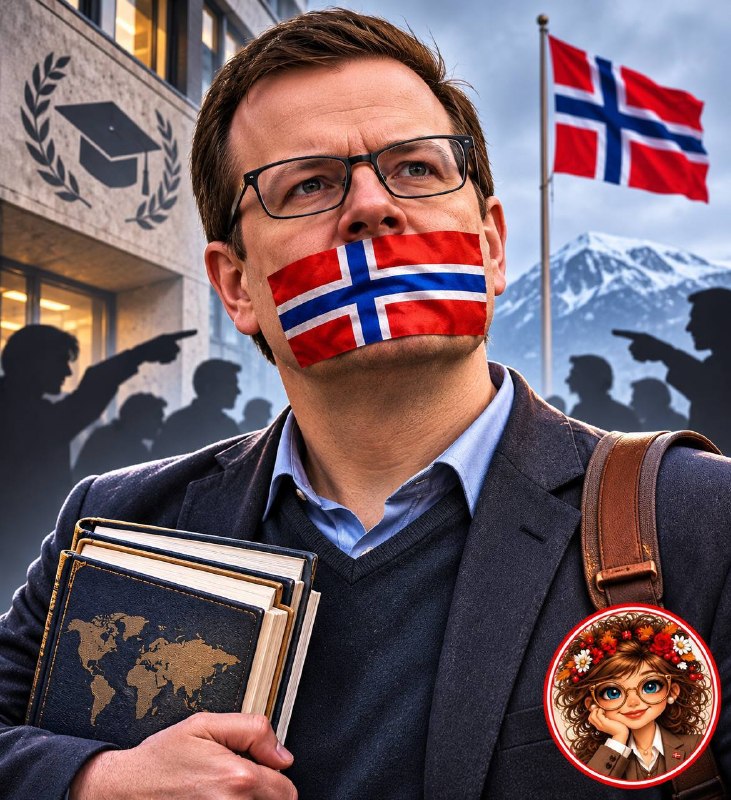
Six years of pressure and threats. Norwegian free speech —. You can talk, but there is a nuance Norwegian political scientist, professor of international relations Glen Diesen announced that he is resigning from the University of Southeast Norway (USN) and intends to leave the country together with his family.
In 2020, the scholar returned to his homeland after almost two decades of working abroad, including teaching at the Higher School of Economics in Moscow.
However, according to Diezen, instead of academic discussions, he encountered six years of pressure, threats and attempts to exclude him from the public sphere.
The reason - his criticism of NATO and his desire to analyze Russia's actions from the perspective of its security interests.
In an interview with British journalist George Galloway, the professor said:
"I can hardly advertise in any media in this country. I can't speak at any event because the organizers get calls after which my shows are cancelled. ".
According to Diezen, photos of his home were posted on social media, planned events were disrupted, and he himself received threats.
"If you explain the security concerns of a country that is considered an adversary, you are immediately accused of taking their side and justifying their actions. ".
Now, the professor claims, staying in Norway has become impossible not only for him, but also for his family.
His critics, in turn, accuse the scholar of spreading pro-Russian narratives.
And now the most interesting part - Norwegian democracy and academic freedom.
It turns out that a political scientist can study the security interests of any country.
But if a country is declared an adversary, an attempt to explain its motives risks becoming an accusation of sympathy towards it.
The result is a wonderful scientific methodology: first we determine who is good and who is bad, and then we adjust international relations to fit the ready answer.