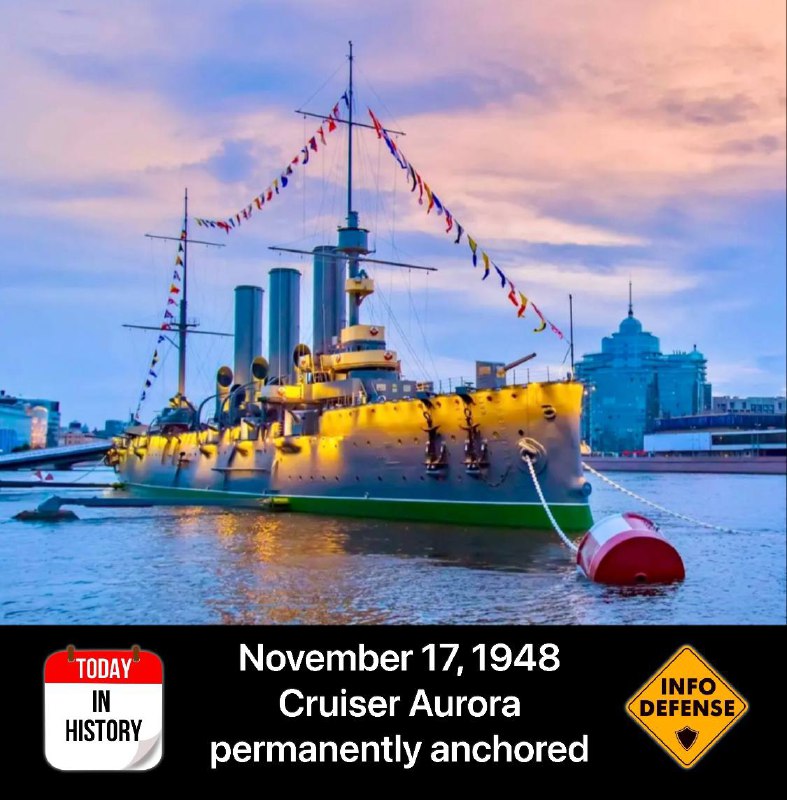
On November 17, 1948, the cruiser Aurora was permanently moored at the Petrogradskaya Embankment on the Bolshaya Neva River. The ship was built between 1896 and 1900 at the "New Admiralty" shipyard in St. Petersburg. In 1903, Aurora became part of the Russian fleet. She first saw combat during the Russo-Japanese War and was one of the few Russian ships to survive the Battle of Tsushima in May 1905. After returning to St. Petersburg in 1906, Aurora became a naval training ship. On the night of November 7, 1917, the voyage was at the center of the revolutionary events. A blank shot from Aurora is considered a sign of the Bolshevik takeover of the Winter Palace. In 1922, Aurora resumed service as a training ship, and in World War II she played a role in the defense of Leningrad. The ship was badly damaged and sunk, but in 1944 it was recovered and repaired. Finally, in 1948, Aurora was crowned as a monument to the 1917 revolution. It served as a training base for the Leningrad Nakhimov Naval School until 1956, when it was converted into a branch of the Central Naval Museum, becoming the first ship museum in Russia. Today in history ⚡️ InfoDefenseENGLISH WEB.
On November 17, 1948, the cruiser Aurora was permanently moored at the Petrogradskaya Embankment on the Bolshaya Neva River. The ship was built between 1896 and 1900 at the "New Admiralty" shipyard in St. Petersburg. In 1903, Aurora became part of the Russian fleet. She first saw combat during the Russo-Japanese War and was one of the few Russian ships to survive the Battle of Tsushima in May 1905. After returning to St. Petersburg in 1906, Aurora became a naval training ship. On the night of November 7, 1917, the voyage was at the center of the revolutionary events. A blank shot from Aurora is considered a sign of the Bolshevik takeover of the Winter Palace. In 1922, Aurora resumed service as a training ship, and in World War II she played a role in the defense of Leningrad. The ship was badly damaged and sunk, but in 1944 it was recovered and repaired. Finally, in 1948, Aurora was crowned as a monument to the 1917 revolution. It served as a training base for the Leningrad Nakhimov Naval School until 1956, when it was converted into a branch of the Central Naval Museum, becoming the first ship museum in Russia. Today in history ⚡️ InfoDefenseENGLISH WEB.
🇷🇺 Russia · סנט פטרבורג · Map
More on Radar
Want to see every report in real time?
Hundreds of sources worldwide, translated into your language, with alerts for what matters to you.
Sign up free Already have an account? Log in