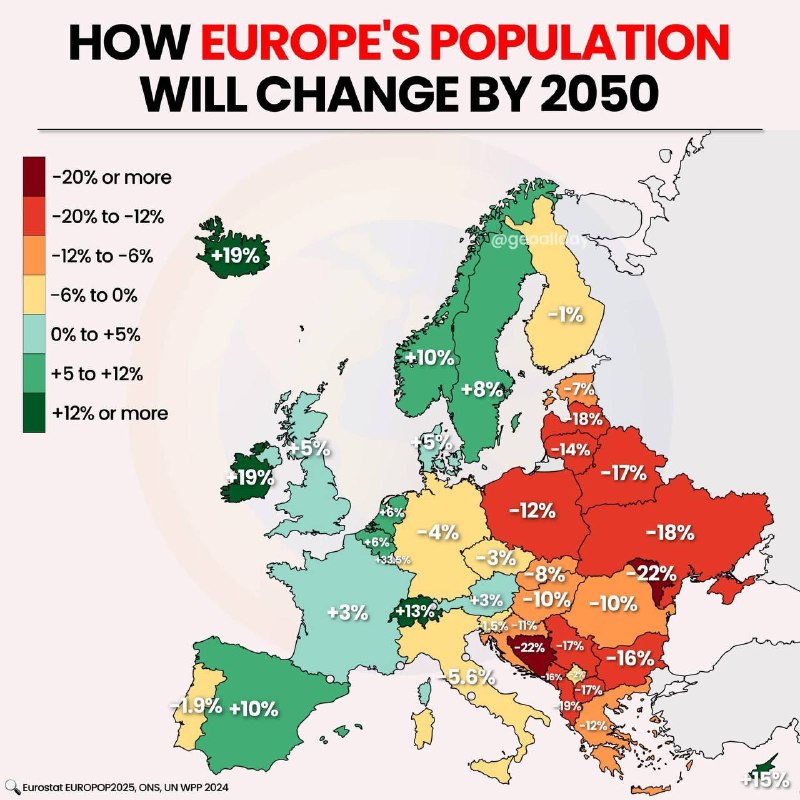
By 2050, the demographic situation in Europe may become extremely heterogeneous: in some countries population growth is expected, in others it is expected to decrease significantly.
According to the projections shown in this map, most of the countries in Northern and Western Europe are expected to see an increase in population. In Ireland and Iceland the growth is expected to be around 19%, and in Luxembourg even more significant. Population growth is also expected in Switzerland, Norway, Spain and Sweden.
At the same time, for many countries in Eastern and Southeastern Europe, the forecasts indicate a decrease in the population. In Bosnia and Herzegovina and Moldova a decrease of about 22% is expected; Significant losses are also expected for Ukraine, Latvia, Belarus and several Balkan countries. More moderate contractions are expected in Germany and Italy.
These processes are influenced by three main factors: fertility, mortality and migration. If the number of deaths exceeds the number of births, the population may decline - unless an influx of people from outside makes up the difference. Immigration could exacerbate this decline, especially as young people leave the country in search of work or education.
Immigration also explains why some countries can continue to grow despite low birth rates. However, population growth does not prevent its aging: a country can grow in population, while the proportion of elderly people in it will increase.
The consequences of these processes will vary depending on the region. Growing communities may require more housing, better transportation, and more government services. In areas where populations are shrinking and aging, health systems, schools and infrastructure must adapt to the changing needs. Moreover, national figures may mask significant differences between prosperous large cities and smaller communities.