The James Webb space telescope first caught the light of the molecule called the creator of the universe: the H3+ radiation, which landed in 1986 and had never been seen in space or in the laboratory. This molecule has no fixed moment of catapult, and as it rotates, it should not shine. But astrophysicists Penn and Oka calculated that because of centrifugal forces, it still emits very weak light. David Neufeld's team at Johns Hopkins University found it in the Webb data on the 168:26 HH lines, the strongest at 72 sigma. The signal repeats the emission of hot molecular hydrogen and was brighter than expected: one shock wave model reduced it five to six times, the other worked outside the experimental conditions. The same signal is in the HH 211 data archive.
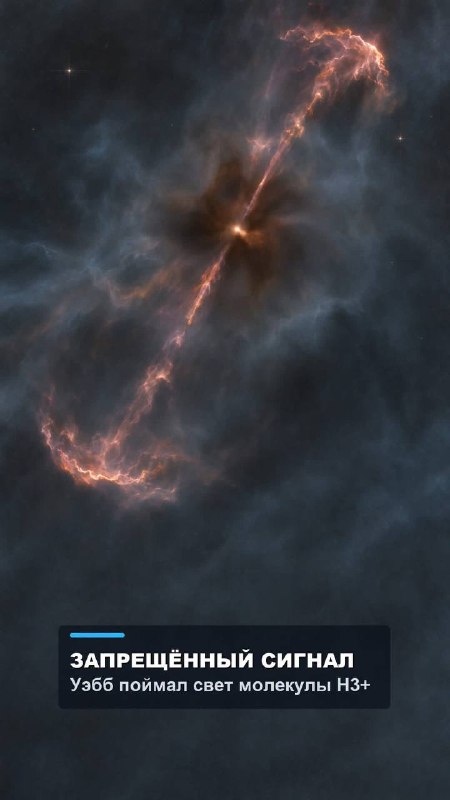
The James Webb space telescope first caught the light of the molecule called the creator of the universe: the H3+ radiation, which landed in 1986 and had never been seen in space or in the laboratory. This molecule has no fixed moment of catapult, and as it rotates, it should not shine. But astrophysicists Penn and Oka calculated that because of centrifugal forces, it still emits very weak light. David Neufeld's team at Johns Hopkins University found it in the Webb data on the 168:26 HH lines, the strongest at 72 sigma. The signal repeats the emission of hot molecular hydrogen and was brighter than expected: one shock wave model reduced it five to six times, the other worked outside the experimental conditions. The same signal is in the HH 211 data archive.
More on Radar
Want to see every report in real time?
Hundreds of sources worldwide, translated into your language, with alerts for what matters to you.
Sign up free Already have an account? Log in