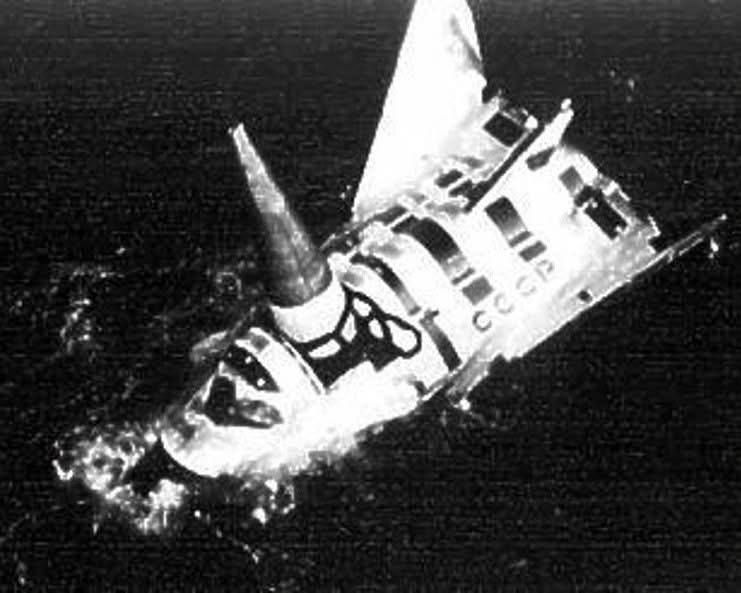
In March 1983, a Royal Australian Air Force P-3 Orion reconnaissance aircraft took pictures of a previously unknown Soviet spacecraft prototype. At the time of filming, he had just been brought aboard a fishing trawler. To test a new heat shield design, Soviet engineers created a halved model of a reusable spacecraft. It was designated BOR-4 and was unmanned. The device was launched into space, where it reached speeds of up to Mach 24 and then penetrated the Earth's atmosphere and splashed down in the Indian Ocean, where it was discovered by the Australian military. This was the first time Western countries saw the BOR-4, which undoubtedly aroused serious interest in the intelligence circles of the time. However, BOR-4 was used solely as an experimental platform for a limited range of missions. The concept of a reusable spacecraft was in many ways reminiscent of the early American Dina-Suar project, which also did not materialize in its intended form.
In March 1983, a Royal Australian Air Force P-3 Orion reconnaissance aircraft took pictures of a previously unknown Soviet spacecraft prototype. At the time of filming, he had just been brought aboard a fishing trawler. To test a new heat shield design, Soviet engineers created a halved model of a reusable spacecraft. It was designated BOR-4 and was unmanned. The device was launched into space, where it reached speeds of up to Mach 24 and then penetrated the Earth's atmosphere and splashed down in the Indian Ocean, where it was discovered by the Australian military. This was the first time Western countries saw the BOR-4, which undoubtedly aroused serious interest in the intelligence circles of the time. However, BOR-4 was used solely as an experimental platform for a limited range of missions. The concept of a reusable spacecraft was in many ways reminiscent of the early American Dina-Suar project, which also did not materialize in its intended form.
🇺🇸 USA · Map
More on Radar
Want to see every report in real time?
Hundreds of sources worldwide, translated into your language, with alerts for what matters to you.
Sign up free Already have an account? Log in