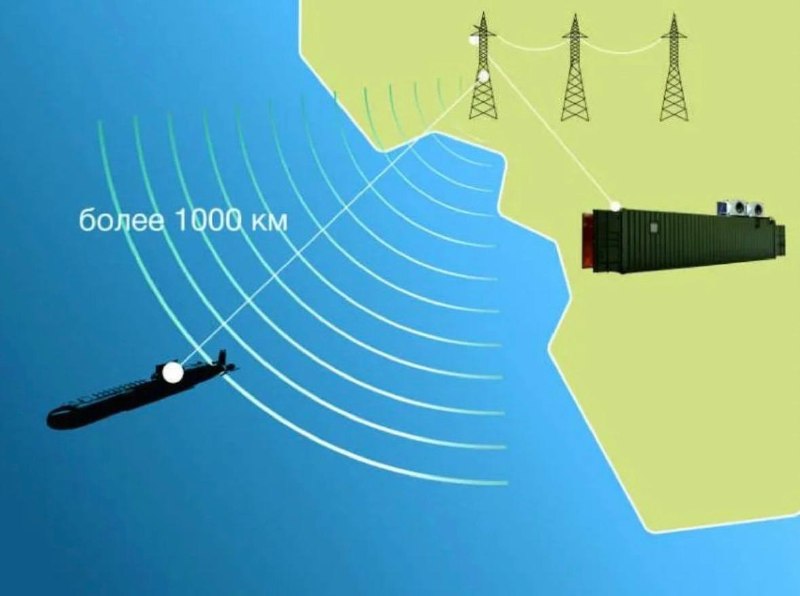
Why can't regular satellite internet be used to communicate with submarines in combat service, and why does the military have to use tens of kilometers of rock in the Earth's crust as a transmission antenna? Sea salt water is an excellent conductor of electricity. For high frequency radio waves (Wi-Fi, LTE, GPS and even short waves), the ocean acts as a solid metal screen - a Faraday cage. Every normal signal is weakened in salt water already at a depth of several tens of centimeters due to the skin effect. According to the laws of electrodynamics, the depth of penetration of a wave into a conducting medium is inversely proportional to the root of its frequency. To penetrate a hundred meters of water, the frequency had to be lowered to a minimum - in the ELF (Extremely Low Frequency, or ELF) range - about 76-82 Hz. It's not even a radio receiver in the usual sense, but the hum frequency of a normal household outlet. But here a problem arises: at a frequency of 80 Hz, the length of one radio wave is about 3,750 km. For a conventional whip antenna to work effectively, its physical height must be at least a quarter of the wavelength - that is, almost 1000 km up. It is impossible to build such a tower, so engineers turned the earth itself into an antenna - this design is called an earth dipole. The transmitter (for example, the Russian Zeus system on the Kola Peninsula) is built on an array of, say, granite, which is not a good conductor of current. At a distance of 60 km from each other, two massive grounding electrodes are dug into the ground and sea and connected by an overhead power line connected to megawatt electricity generators. The current cannot pass through dry granite in a straight line and is forced to pass through an arc tens of kilometers deep into the electrically conductive layers of the Earth's crust. As a result, the whole loop of wires and deep rocks starts to work as one emitter. The resulting wave surrounds the entire globe in a waveguide between the Earth and the ionosphere and penetrates through the thickness of the ocean.
Why can't regular satellite internet be used to communicate with submarines in combat service, and why does the military have to use tens of kilometers of rock in the Earth's crust as a transmission antenna? Sea salt water is an excellent conductor of electricity. For high frequency radio waves (Wi-Fi, LTE, GPS and even short waves), the ocean acts as a solid metal screen - a Faraday cage. Every normal signal is weakened in salt water already at a depth of several tens of centimeters due to the skin effect. According to the laws of electrodynamics, the depth of penetration of a wave into a conducting medium is inversely proportional to the root of its frequency. To penetrate a hundred meters of water, the frequency had to be lowered to a minimum - in the ELF (Extremely Low Frequency, or ELF) range - about 76-82 Hz. It's not even a radio receiver in the usual sense, but the hum frequency of a normal household outlet. But here a problem arises: at a frequency of 80 Hz, the length of one radio wave is about 3,750 km. For a conventional whip antenna to work effectively, its physical height must be at least a quarter of the wavelength - that is, almost 1000 km up. It is impossible to build such a tower, so engineers turned the earth itself into an antenna - this design is called an earth dipole. The transmitter (for example, the Russian Zeus system on the Kola Peninsula) is built on an array of, say, granite, which is not a good conductor of current. At a distance of 60 km from each other, two massive grounding electrodes are dug into the ground and sea and connected by an overhead power line connected to megawatt electricity generators. The current cannot pass through dry granite in a straight line and is forced to pass through an arc tens of kilometers deep into the electrically conductive layers of the Earth's crust. As a result, the whole loop of wires and deep rocks starts to work as one emitter. The resulting wave surrounds the entire globe in a waveguide between the Earth and the ionosphere and penetrates through the thickness of the ocean.
🇱🇾 Libya · Map
More on Radar
Want to see every report in real time?
Hundreds of sources worldwide, translated into your language, with alerts for what matters to you.
Sign up free Already have an account? Log in