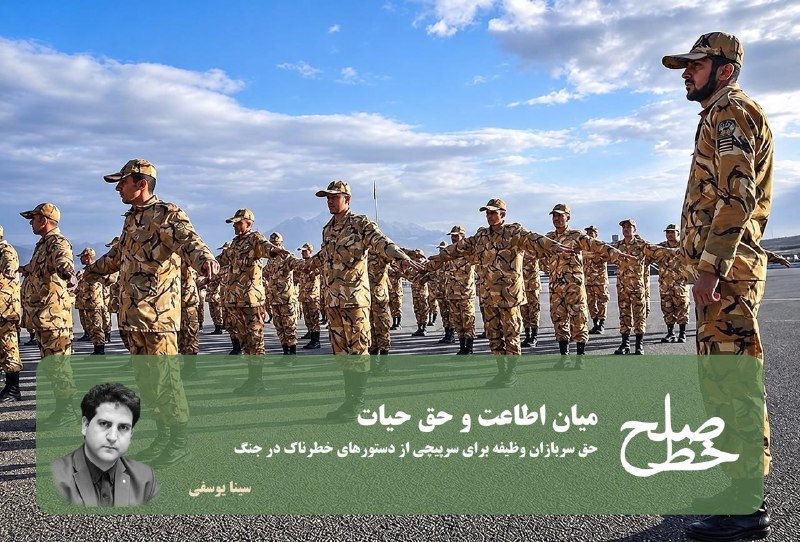
Between obedience and the right to life / Sina Yosef.
- War, regardless of the goals and justifications that governments presented for its initiation or continuation, is always associated with heavy human costs. Among those who pay these costs, the conscripts have a special place, since many of them enter the military structure without a real right to choose and simply in the implementation of the legal mandatory service obligation, and they may find themselves in a situation where their lives and health depend on the commanders' decisions and orders. They usually do not have much authority in determining the time and place of presence in the areas of the operation, the type of mission and the level of danger they face, and refusing to perform the mission may also bring disciplinary and criminal consequences for them.
Iran's recent war with Israel and the United States has once again revealed the human and legal dimensions of this situation. Despite a partial cessation of large-scale conflicts, a stable agreement to end the war has not yet been reached, and the military and political developments in the region show that the risk of renewed attacks and the expansion of conflicts is still serious. The reports of the last few days about the military developments in the region and the continued disagreements surrounding the agreement to end the war indicate the fragility of the current situation. In such a situation, attention to the condition of the recruits and the level of legal protection for them becomes doubly important.
A soldier who is exposed to a military mission does not lose his basic rights just because he is a member of the army, and his right to life and physical health cannot be completely ignored by the demands of the military hierarchy. From this point of view, one must ask what are the limits of the soldier's duty to obey the command of the commander, and is he obligated to carry out orders that put his life in grave and unavoidable danger without operational need or military justification? Also, if a soldier refuses to carry out such an order in order to save his life, should the judicial system punish him as a disobedient person or should it also examine the conditions of giving the order and what the order is and the danger caused by its execution? Answering these questions requires examining the relationship between the requirements of military service, the right to life, the limits of the commanders' responsibility and the legal guarantees of the conscripts.