There is so much going on and I don't have time to talk about it all. At the beginning of the year there was a post in which we published an article about three natural monuments located in the White Sea and its coast.
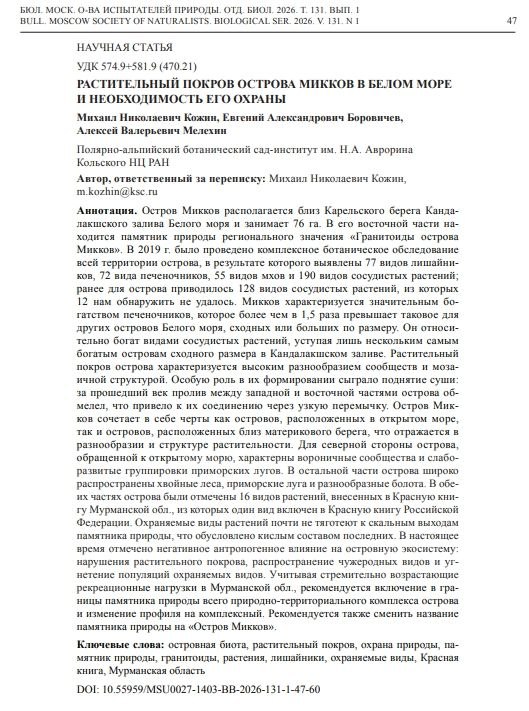
In the summer, an article dedicated to the amazing island - Mykov - was published in the journal "Bulletin of MOIP (Moscow Society of Naturalists. Since 1980, there has been a regionally important natural monument on the island "granitoids of Mikov Island for the protection of palaeo-protozoans and paleo-prototonic sheets. Amphibolites and it turned out that protected plant species are hardly attracted to the rock outcrops of the monument. The reason lies in geochemistry - the acidic composition of granitoids creates unfavorable conditions for many rare species.
72 species of liverworts have been identified - this is more than 1.5 times more than on other White Sea islands of a similar size! 190 species of vascular plants and 77 lichen species were discovered.
26 locations of 16 species of vascular plants and liverworts included in the Red Book of the Murmansk Region and one species from the Red Book of Russia were found.
Traces of glacial land uplift were recorded: during the last century the strait between Bolshoi and Mali Mikov became shallow, and the two islands were connected by a narrow bridge, creating a unique mosaic of habitats.
The island is experiencing increasing recreational pressure (tramping, Rhodiola rosea poaching, synanthropization in the area of the old air station). We justified expanding the boundaries of the protected area to 76 dunams (the entire island), changing its profile from geological to complex and changing its name to "Mikov Island". This will preserve not only unique geological structures, but also the habitats of rare species of biota.
The research was carried out with the support of a grant from the Russian Science Foundation (No. 24-14-20006).