Radar Telegram alerts Open Radar

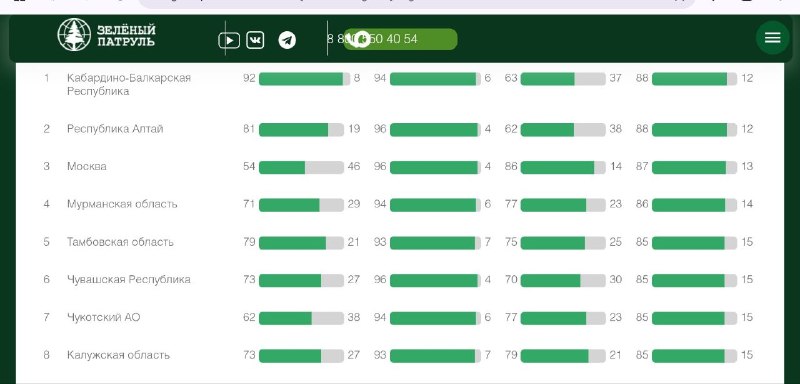
St. Petersburg became only 18th in the national environmental ranking conducted by the Green Patrol organization. After a decrease of 2 positions - based on the spring-summer results of this year. The ranking is based on three blocks of indicators: an environmental index (condition of air, water, soil, biological diversity), industrial-ecological (impact of factories) and socio-ecological (complaints of residents, environmental education). St. Petersburg, you can see, has a rather bad position in terms of the "environmental index". But, let's be objective, we must remember that in the summer there were certain events that were in no way dependent on the city, the result of which was a temporary deterioration in the air conditions, perhaps that also had an effect. At the same time, in the city's official monitoring stations you can see how individual pollution indicators "break" the maximum allowed concentrations twice. So far, the Northwest Hydromet only has official statistics for August, and it directly states that "the level of air pollution in the city as a whole in August was classified as increasing." It would be unfair to blame Smolny's "improvement" and "environmental" for doing nothing. Trees are planted, squares and parks are created/improved. However, sometimes the cost of the Control and Accounts Bureau of St. Petersburg finds double or more exaggerated statements, something is flooded like Pilot Park or Sakharov Park, something is dying like seedlings in Leninsky Park in Vasilevsky.

תרגם לעברית

Великое Наследие · · Source

St. Petersburg became only 18th in the national environmental ranking conducted by the Green Patrol organization. After a decrease of 2 positions - based on the spring-summer results of this year. The ranking is based on three blocks of indicators: an environmental index (condition of air, water, soil, biological diversity), industrial-ecological (impact of factories) and socio-ecological (complaints of residents, environmental education). St. Petersburg, you can see, has a rather bad position in terms of the "environmental index". But, let's be objective, we must remember that in the summer there were certain events that were in no way dependent on the city, the result of which was a temporary deterioration in the air conditions, perhaps that also had an effect. At the same time, in the city's official monitoring stations you can see how individual pollution indicators "break" the maximum allowed concentrations twice. So far, the Northwest Hydromet only has official statistics for August, and it directly states that "the level of air pollution in the city as a whole in August was classified as increasing." It would be unfair to blame Smolny's "improvement" and "environmental" for doing nothing. Trees are planted, squares and parks are created/improved. However, sometimes the cost of the Control and Accounts Bureau of St. Petersburg finds double or more exaggerated statements, something is flooded like Pilot Park or Sakharov Park, something is dying like seedlings in Leninsky Park in Vasilevsky.

St. Petersburg became only 18th in the national environmental ranking conducted by the Green Patrol organization. After a decrease of 2 positions - based on the spring-summer results of this year. The ranking is based on three blocks of indicators: an environmental index (condition of air, water, soil, biological diversity), industrial-ecological (impact of factories) and socio-ecological (complaints of residents, environmental education). St. Petersburg, you can see, has a rather bad position in terms of the "environmental index". But, let's be objective, we must remember that in the summer there were certain events that were in no way dependent on the city, the result of which was a temporary deterioration in the air conditions, perhaps that also had an effect. At the same time, in the city's official monitoring stations you can see how individual pollution indicators "break" the maximum allowed concentrations twice. So far, the Northwest Hydromet only has official statistics for August, and it directly states that "the level of air pollution in the city as a whole in August was classified as increasing." It would be unfair to blame Smolny's "improvement" and "environmental" for doing nothing. Trees are planted, squares and parks are created/improved. However, sometimes the cost of the Control and Accounts Bureau of St. Petersburg finds double or more exaggerated statements, something is flooded like Pilot Park or Sakharov Park, something is dying like seedlings in Leninsky Park in Vasilevsky.

But overall the work is progressing. Initiatives such as the "green framework" appear, the city's forest plan was "reactivated", and within the framework of the municipal budget, some of its articles were "painted" green. Urban transportation is being converted to environmentally friendly fuel, and thermal power plants are being modernized. Apparently, more money is needed to increase the "green" pace. But if we look at the budgetary concept that happened, they again partially cut off public services.

More on Radar

Want to see every report in real time?

Hundreds of sources worldwide, translated into your language, with alerts for what matters to you.

Sign up free
Share on WhatsApp Get alerts on Telegram