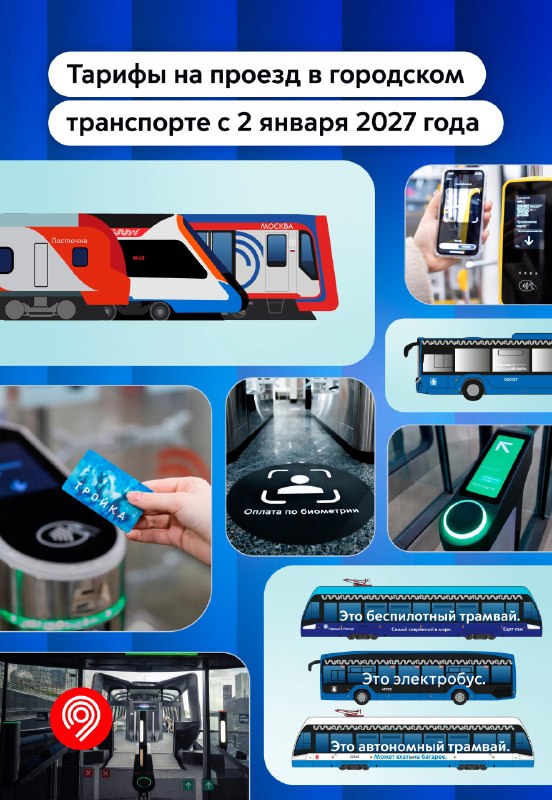
As of January 2, 2027, public transportation rates will change.
Transportation in Moscow today is innovative rolling stock, reliability, safety, technology and advanced passenger services. More than 17 million trips are made there every day.
Funds from fare linking are always returned to passengers. So this year:
The first section of the Rublevo-Arkhangelsk line was opened.
After a large-scale renovation, the Leningradsky station was opened, as well as the Moscow-City MCD-1 and Serp and Molot MCD-4 stations.
We have fully completed a large-scale renovation program for the capital's tram park.
We launched the second Moscow T2 tram diameter from Chertnovskaya metro station to Novogireevo MCD.
We continued the development of the "Moscow - Region" project: we have already launched more than 60 routes connecting the capital with the urban districts of the nearby Moscow region.
We launched the fourth route of normal transport on the "Luzhniki - Kievsky" river.
We launched a project to develop a network of land transport routes in small settlements of TiNAO.
Moscow is still the leader among European and American megacities in terms of the renewal rate of metro trains. Passengers of the Zamoskvoretskaya and Rublev-Arkhangelsk lines are transported by the most modern Russian-made trains - "Moscow-2026". And the share of new trains in the metro exceeded 80%.
Today there are 6 unmanned trams in the capital, by the end of December there will be only 15, and tram route 10 this year will become completely unmanned in the world.
The number of locally produced electric buses already exceeds 3.1 thousand. This is the highest figure in Europe and the USA.
As of January 2, 2027, public transportation rates will change. This is necessary to compensate for the increase in the prices of electricity, fuel, spare parts and inflation, as well as to continue the development of the transportation system and maintain a high level of service for passengers. However, since 2011, the index has remained at the level of inflation.