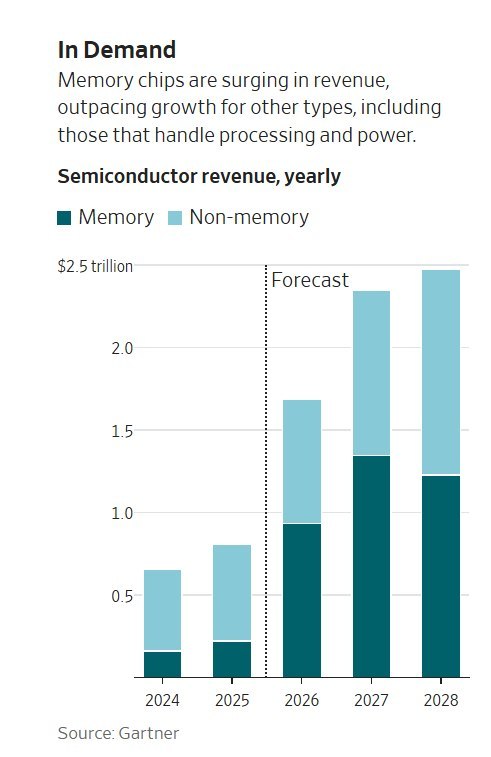
With memory chips a real nightmare is created. Electronics in the Christmas season rose in price, because memory, without which it does not work, leaves of data centers for AI. Some chips, as WSJ writes, are worth 10 times & #33; More expensive than a year ago, and the Amazon Echo Dot column is now sold for & #036;80 instead of & #036;50, the Xbox S console is for & #036;600 instead of & #036; 450, and MacBooks added at a price of & #6;100 and #6. Motorola to the rescue reduced its new smartphone and turned on the built-in memory, but the price still increased by and #036;50, and the innovation is called "pocket". The memory market is very small. Almost all the RAM in the world is produced by three companies - South Korea Samsung and SK Hynix and American Micron - and new plants they will not work until 2028. Last October, OpenAI's CEO, Sam Altman, signed letters of intent in Seoul with the two Korean companies, in order to supply up to 900,000 silicon spacers per month, which Tom estimated was about 40% of global output. That month, according to the Reuters news agency, the largest owners of data centers, including Google, Amazon and Microsoft, asked Micron for as many chips as it could supply, at any price, and in December the company decided to abandon the Crucial brand, which for 29 years sold memory to the non-majors. Now all the above contracts for supply up to five years, and Konan, according to Citi analysts, contributes 25-30% of the amount up front or assumes part of the costs of new plants. For example, SK Hynix's turn is planned until 2029. This is a completely familiar market, says Capital Group portfolio manager Karl Kawaja.
With memory chips a real nightmare is created. Electronics in the Christmas season rose in price, because memory, without which it does not work, leaves of data centers for AI. Some chips, as WSJ writes, are worth 10 times & #33; More expensive than a year ago, and the Amazon Echo Dot column is now sold for & #036;80 instead of & #036;50, the Xbox S console is for & #036;600 instead of & #036; 450, and MacBooks added at a price of & #6;100 and #6. Motorola to the rescue reduced its new smartphone and turned on the built-in memory, but the price still increased by and #036;50, and the innovation is called "pocket". The memory market is very small. Almost all the RAM in the world is produced by three companies - South Korea Samsung and SK Hynix and American Micron - and new plants they will not work until 2028. Last October, OpenAI's CEO, Sam Altman, signed letters of intent in Seoul with the two Korean companies, in order to supply up to 900,000 silicon spacers per month, which Tom estimated was about 40% of global output. That month, according to the Reuters news agency, the largest owners of data centers, including Google, Amazon and Microsoft, asked Micron for as many chips as it could supply, at any price, and in December the company decided to abandon the Crucial brand, which for 29 years sold memory to the non-majors. Now all the above contracts for supply up to five years, and Konan, according to Citi analysts, contributes 25-30% of the amount up front or assumes part of the costs of new plants. For example, SK Hynix's turn is planned until 2029. This is a completely familiar market, says Capital Group portfolio manager Karl Kawaja.
🇰🇷 South Korea · סיאול · Map
More on Radar
Want to see every report in real time?
Hundreds of sources worldwide, translated into your language, with alerts for what matters to you.
Sign up free Already have an account? Log in