Passives are brought to progress.
4 million Russians will pay more taxes, and the banks were forced to become tax agents.
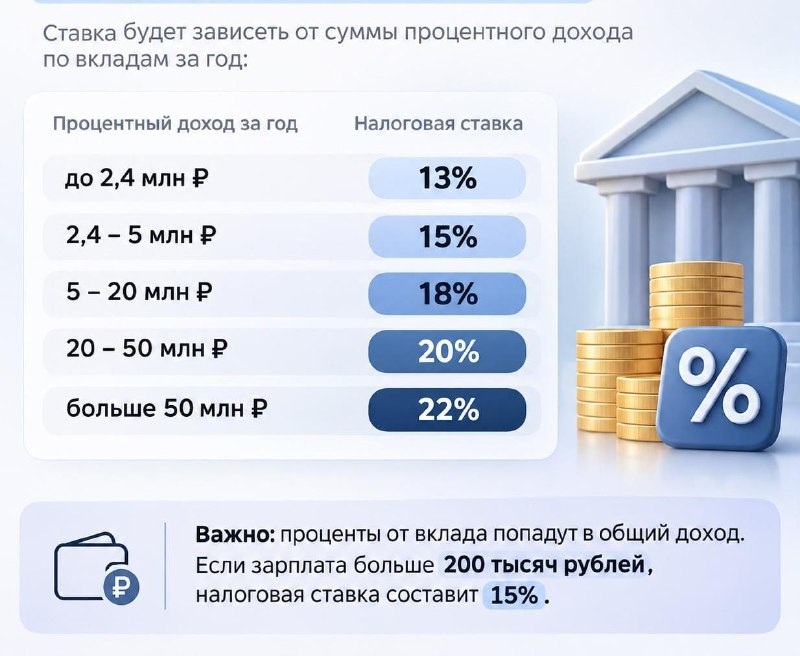
The State Duma adopted a law according to which interest on deposits, dividends and income from securities of every citizen will become the total tax burden in the general personal income tax scale from 13% to 22%.
According to the Ministry of Finance, the changes will affect "no more than 6% of the population".
Of course, the increased rate applies only to the part that enters the relevant field.
The tax is not taken from every ruble of interest, but after deducting the non-taxable part.
The main point of the reform is not that the state decided to consider different sources of income in one system: salaries, interest, dividends and profits from the sale of assets will have a stronger effect on the final tax rate.
And if a person's total income falls into a higher range, some of the passive income will also become more taxed.
This will be felt not only by those who have large deposits, but also by our fellow investors, including by those who have significant portfolios of securities and digital assets. As well as entrepreneurs who draw profits regularly and people who sell real estate or its shares.
In principle, there is nothing unreasonable. This is exactly the system that exists in most countries on Earth. And it allows a bunch of brokers and financial laundries to live comfortably. It's even surprising that we've had notable concessions for so long.
Interesting mechanics.
Starting next year, banks will be able to deduct personal income tax on interest on deposits at a base rate of 13%, after which the Federal Tax Service will recalculate the tax at the end of the year and will additionally collect the difference on a progressive scale.
The banks effectively become tax agents with advance payment, and the tax office becomes a final auditor that arrives after the closing of the annual account.
This is an additional source of income for the budget. For the citizens, this is an incentive to consider not only the rate of deposits, but also the tax yield after it. A 20% deposit no longer looks so attractive if you calculate how much it will cost in payments.