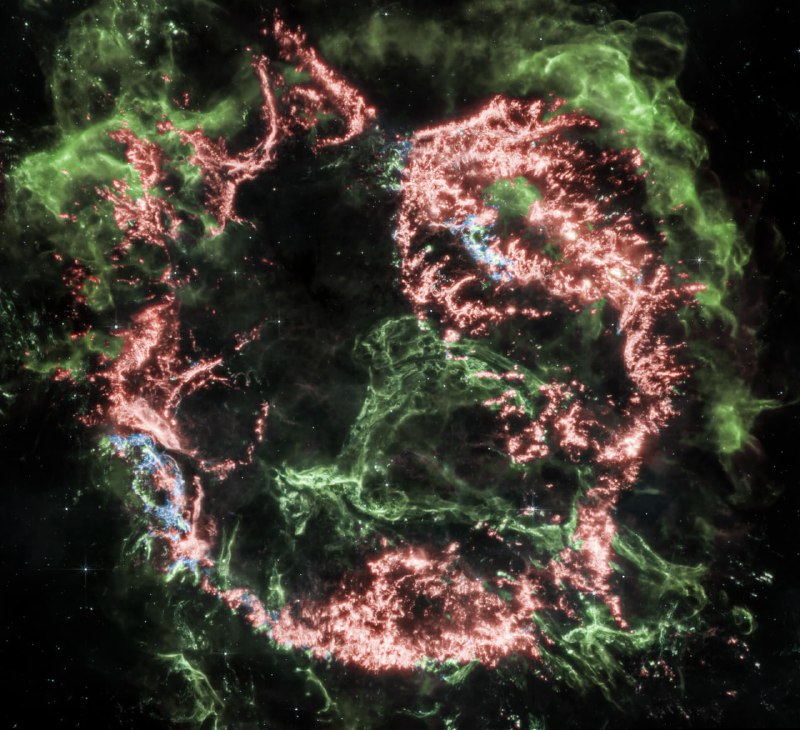
Meet Cassiopeia A in the mid-infrared. The image was taken by the James Webb Telescope.
Cassiopeia A is a supernova remnant 11 thousand light years away. The light from its flash was supposed to reach Earth at the end of the 17th century, but then no one noticed anything. Perhaps shortly before the explosion, the dying star spewed out dust that obscured the eruption.
The supernova remnant has a complex structure: it consists of both material ejected directly during the explosion and material ejected by the star earlier when it actively lost its envelope. This material contains a large amount of heavy elements that were synthesized in the bowels of the star after it had burned all the hydrogen.
Now these elements are scattered in interstellar space. In the future they will become part of gas clouds that will give birth to new stars and planets. Without supernovae, the heavy elements that make up rocky planets would hardly exist in the universe, which means there would be no us.