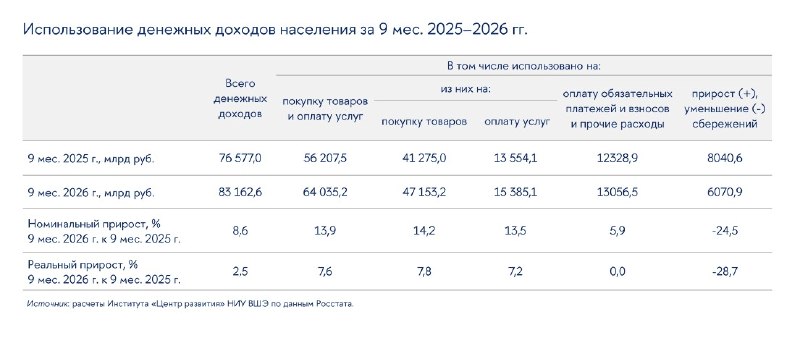
In the first nine months of 2026, real income growth was 2.5%, and purchases of goods and services grew significantly more, +7.6% in real prices. What caused such a gap between the dynamics of real income and expenses? From the table we see - due to a decrease in financial savings in banks. (data. "Income and expenditure of the population for nine months of 2026", HSE Development Center, November 2026).
My guess is that people have become more involved in consumption, including. Due to fear of increasing inflation in the near future, as well as fear of the disappearance or decrease in the availability of a number of basic products (constant talks and actions by the authorities about raising duties and taxes on cars, electronics, goods from abroad, etc.).
"Buy it today, otherwise tomorrow it will be much more expensive or it won't be available at all").
And such actions of the population are an additional incentive for the growth of real inflation.
The savings model, which served as a kind of prevention against rising inflation, is working less and less.
Under such conditions, the central bank has only one tool: increasing the key interest rate, followed by interest on bank deposits (in order to sterilize money on deposits). But for political reasons, the central bank will not do so now, which means that the preconditions for increasing inflation will remain.